Jeep Articulation
Test in Houston, TX
You don't know what your Jeep can actually do until you put it on a ramp and measure it. Most owners are guessing. Here's how to stop guessing.
RTI ramp test. Results data sheet with your actual score. Recommendations on what's limiting your flex and how to fix it. A 30-minute conversation with the builder who knows your platform. If you're wondering how much flex is good, what long arm actually changes, or where to find an RTI ramp in Houston — this session answers all of it.
Appointments required · 6420 Westheimer Rd, Houston TX · (713) 555-0140
What Is Articulation — and Why Does It Matter?
Articulation is how much your suspension can flex — specifically, how far one wheel can drop into a hole while the opposite wheel stays planted on the surface above. It is the difference between a Jeep that can maintain traction on broken terrain and one that lifts a tire and loses power to the ground the moment the surface gets uneven.
When a tire lifts off the ground on a trail, traction goes to zero at that corner. If you don't have a locker, the open differential sends power to the lifted wheel — the one that's spinning in the air — instead of to the wheels that are actually touching something. Maximum flex means maximum tire contact. Maximum tire contact means maximum traction. Traction is what gets you up the obstacle and back to the trailhead.
On the road, suspension flex is a liability — you want stiff anti-roll bars and controlled body motion. On a trail, those same anti-roll bars are your biggest enemy. The factory sway bar that makes your JK feel planted on the highway is the single biggest thing preventing your Wrangler from flexing off-road. These are two completely different jobs that the factory suspension tries to do simultaneously. Understanding this is the starting point for every articulation conversation.
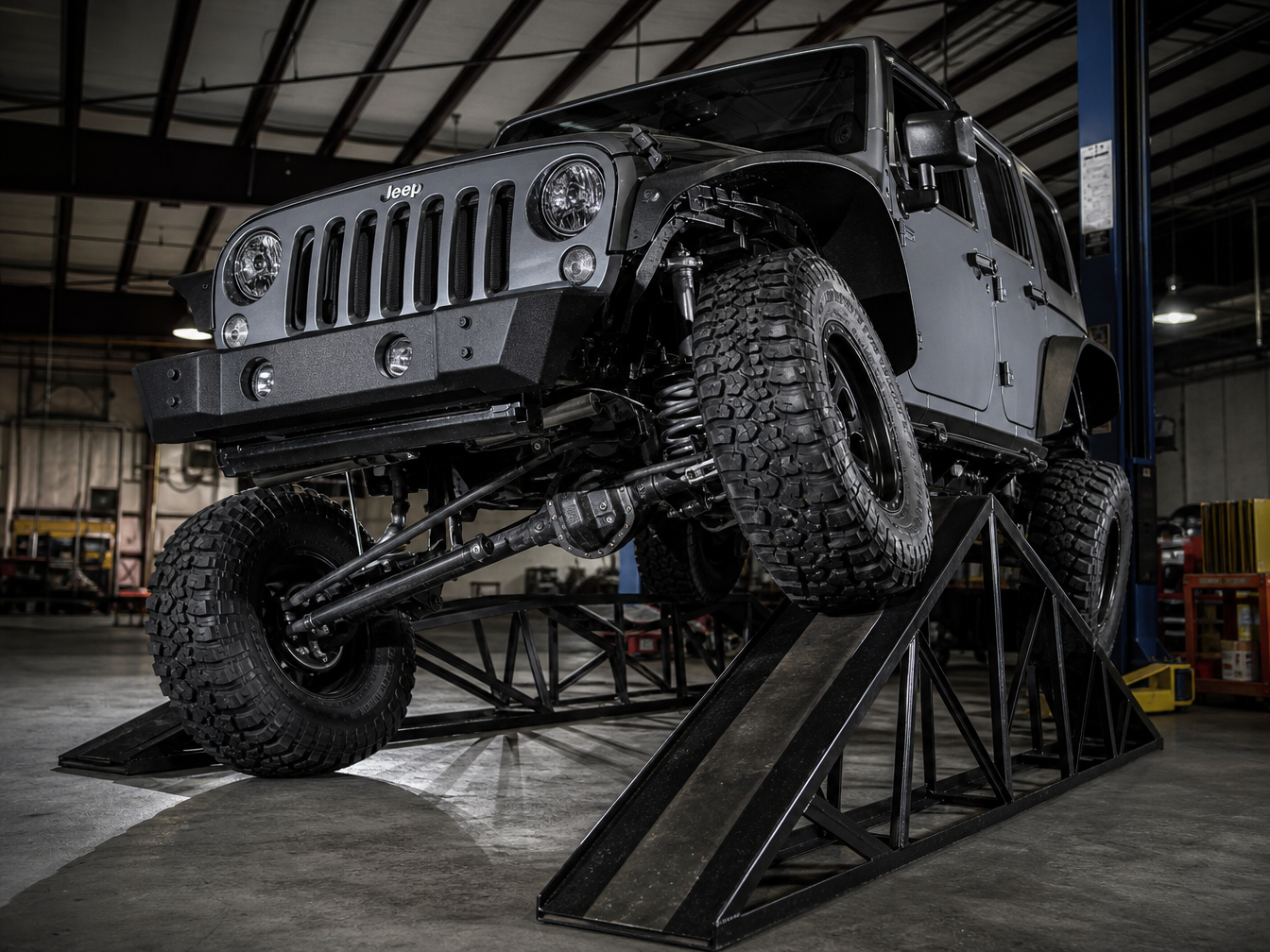
RTI = Ramp Travel Index. The industry standard measurement for vehicle articulation. A Jeep drives onto a ramp at a fixed angle (typically 20°) until one front tire lifts. The ramp height at lift-off divided by the wheelbase, multiplied by 1,000. The result is your RTI score.
Higher score = more articulation. A score of 1,000 means the vehicle traveled a ramp height equal to its wheelbase. This is the math that makes different-wheelbase vehicles comparable on the same metric.
What's a Good RTI Score for a Jeep Wrangler?
RTI scores vary by platform, trim, and modification level. Here is the full scoring range with real-world platform context — so you know where your Jeep should be before you put it on the ramp.
| Platform / Trim | Stock RTI (Sway Bar Connected) | Stock RTI (Sway Bar Disconnected) | Notes |
|---|---|---|---|
| JK Wrangler Sport/Sahara | ~350–380 | ~480–520 | No electronic disconnect — manual QuickDisconnects required |
| JK Wrangler Rubicon | ~420–450 | ~600–650 | Electronic front disconnect standard |
| JL Wrangler Sport/Sahara | ~330–360 | ~460–500 | Stiffer factory sway bar than JK — bigger disconnect benefit |
| JL Wrangler Rubicon | ~410–440 | ~580–620 | Electronic front disconnect. MFC sway bar tuned for trail |
| Gladiator JT Rubicon | ~400–430 | ~560–600 | Longer wheelbase lowers score vs comparable JL at same flex |
| Cherokee XJ (stock) | ~350–400 | ~450–500 | No disconnect — leaf spring front (pre-1985) or coil, no anti-roll management factory |
| TJ Wrangler Rubicon | ~450–480 | ~620–660 | Coil springs + shorter wheelbase = better baseline than JK/JL |
Six Things That Kill Jeep Articulation
Your Jeep's flex is limited by the weakest link in the suspension chain. Here are the six most common limiters — ranked by impact. Our articulation test identifies which ones are at work on your specific rig.
The front sway bar is the single biggest limiter on most Wranglers. It is designed to prevent body roll on pavement — which it does very well. Off-road, it mechanically links the left and right suspension, preventing one side from dropping independently while the other rises. Connecting sway bar = suspension that moves as a unit. Disconnecting it is the fastest, cheapest articulation improvement available on any Jeep.
Factory bump stops prevent the suspension from bottoming out — a necessary function that protects the drivetrain. But factory bump stop lengths are set conservatively for on-road use where bottoming out is an embarrassing handling failure. On trail, that conservative bump stop reaches contact well before the suspension has used its full available travel, physically stopping flex before the spring or shock reaches its limit.
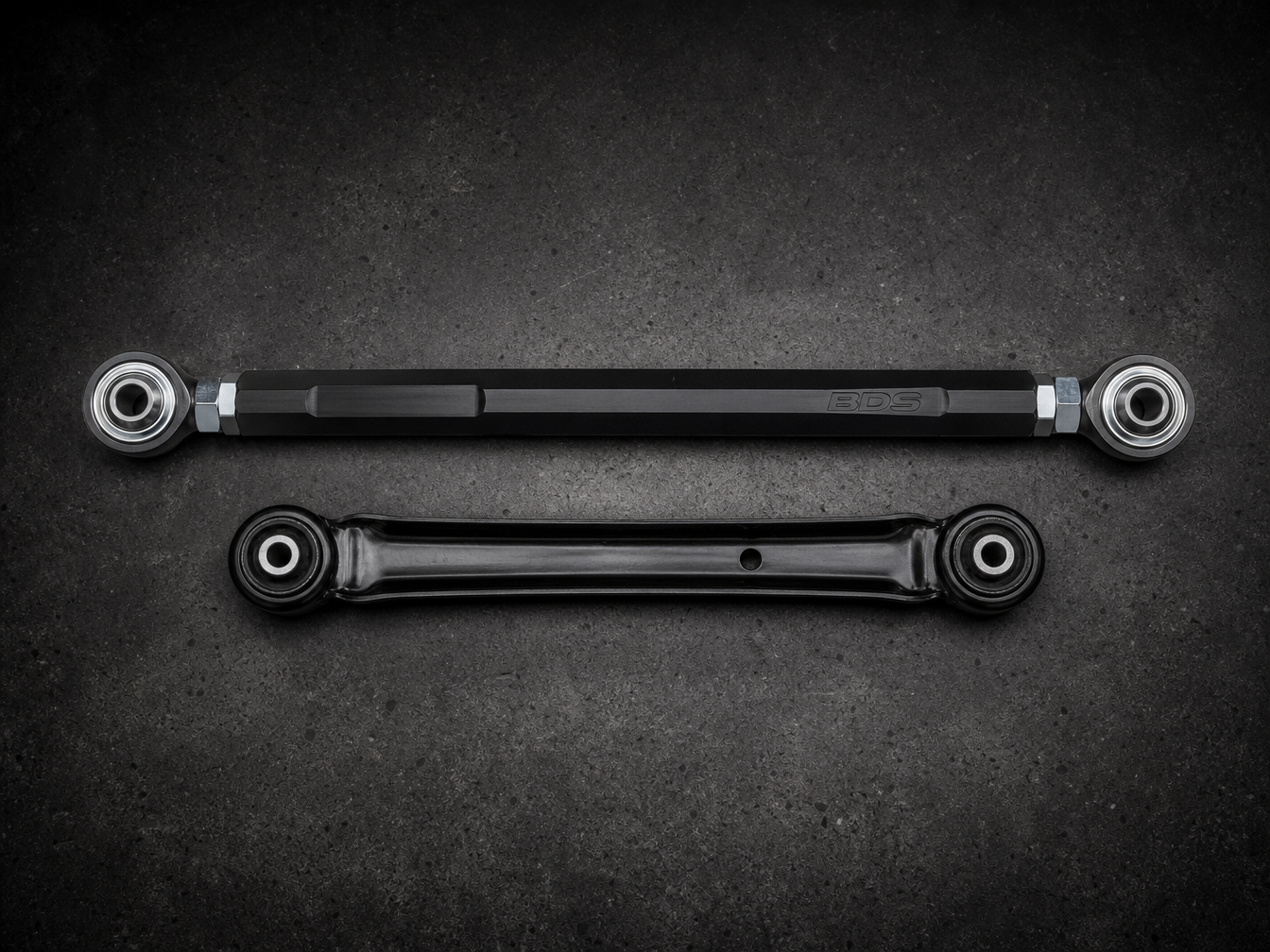
Short arm suspension (factory and most Stage 1 kits) runs the front lower control arm at a relatively steep angle when the suspension is at ride height. As the suspension droops — which is what happens when a tire drops into a hole — that angle becomes increasingly severe until the control arm geometry "binds" against its pivot mount. This binding physically prevents further droop before the spring or shock is at its limit. It is the reason that short arm builds at 4"+ lift hit a flex ceiling that longer control arm lengths address. Uncorrected control arm geometry after a lift does not just cap flex — it is also a common ingredient in death wobble.
A spring that is stiff enough to handle maximum payload and maintain ride height under load is also stiff enough to resist the downward droop that produces articulation. Many aftermarket lift springs are over-rated for typical Wrangler weights — because they are designed to fit the full range of configurations from a stock-weight JK to a fully loaded overland JL with 500 lbs of gear. A spring that barely sags under maximum overland load is significantly stiffer than you need for a daily driver trail rig, and stiffer springs produce lower RTI scores.
A shock absorber limits droop travel when it reaches full extension. If your shocks extended length is shorter than the amount of droop your springs and control arms could allow, the shock is the limiting factor — not the spring or the geometry. Many Stage 1 and budget Stage 2 lifts run shocks that are not spec'd for the full available travel of the lift height. The RTI ramp reveals this clearly: the shock bottoms out on extension before the suspension reaches its geometric limit.
On heavily lifted Wranglers, the coil spring can contact the sides of the coil bucket — the cup that holds the spring in position — before the suspension reaches full droop. This coil bind absorbs the remaining spring travel and prevents further compression in the downward direction. It is most common on budget long arm lifts and Stage 3 builds where spring length and bucket geometry were not calculated together as a system.
Long Arm vs Short Arm vs Factory — What the Ramp Actually Shows
This is the question we get every week. "I've got a Stage 1 short arm lift — is long arm actually worth it for articulation?" The answer is measurable. Here's what the three systems do differently — and what the RTI ramp shows when you compare them side by side.
| System | Articulation Potential | On-Road Manners | Cost | Best For |
|---|---|---|---|---|
| Factory Stock | Limited — sway bar connected | Best — designed for highway | $0 | Daily commuting only |
| Factory + Disconnects | Moderate — geometry still limits droop | Good — disconnects for trail, reconnect for road | $100–$300 | Stage 0 improvement, biggest bang per dollar |
| Short Arm Lift (2.5"–4") | Good up to ~3.5" — geometry bind above that | Good — shorter arm = less on-road wander | $1,500–$4,500 | Stage 1 daily driver, most Houston trails |
| Long Arm Lift (3.5"–5") | Very good — arm angle allows full spring travel | Slightly more on-road feedback — manageable | $4,500–$9,000 | Stage 2 trail, 37"+ builds, serious flex goals |
| Custom 4-Link | Maximum — geometry designed for target travel | Requires careful geometry spec for highway use | $10,000+ | Stage 3, rock crawlers, competition builds |
Forum debates about short arm vs long arm run thousands of posts without resolution because nobody in the thread has put their specific rig on a ramp and measured it. Your RTI score at your lift height with your springs and shocks is the only number that matters for your build decision. We produce that number and build the recommendation from it.
What You Get for $150
This is not a sales appointment. It is a diagnostic session with a 30-minute debrief. If your Jeep needs nothing, we will tell you that. If it has three things limiting its flex and one of them is a $60 bump stop spacer, we will tell you that first before we mention the suspension upgrade it would eventually benefit from.
RTI Ramp Test
Your Jeep goes on the ramp. We run it to tire lift on the front and document the ramp height and corresponding RTI score. Tested with sway bar connected and disconnected to show the isolation contribution of the bar. Tested loaded and unloaded on relevant builds where gear weight changes the suspension behavior.
Results Data Sheet
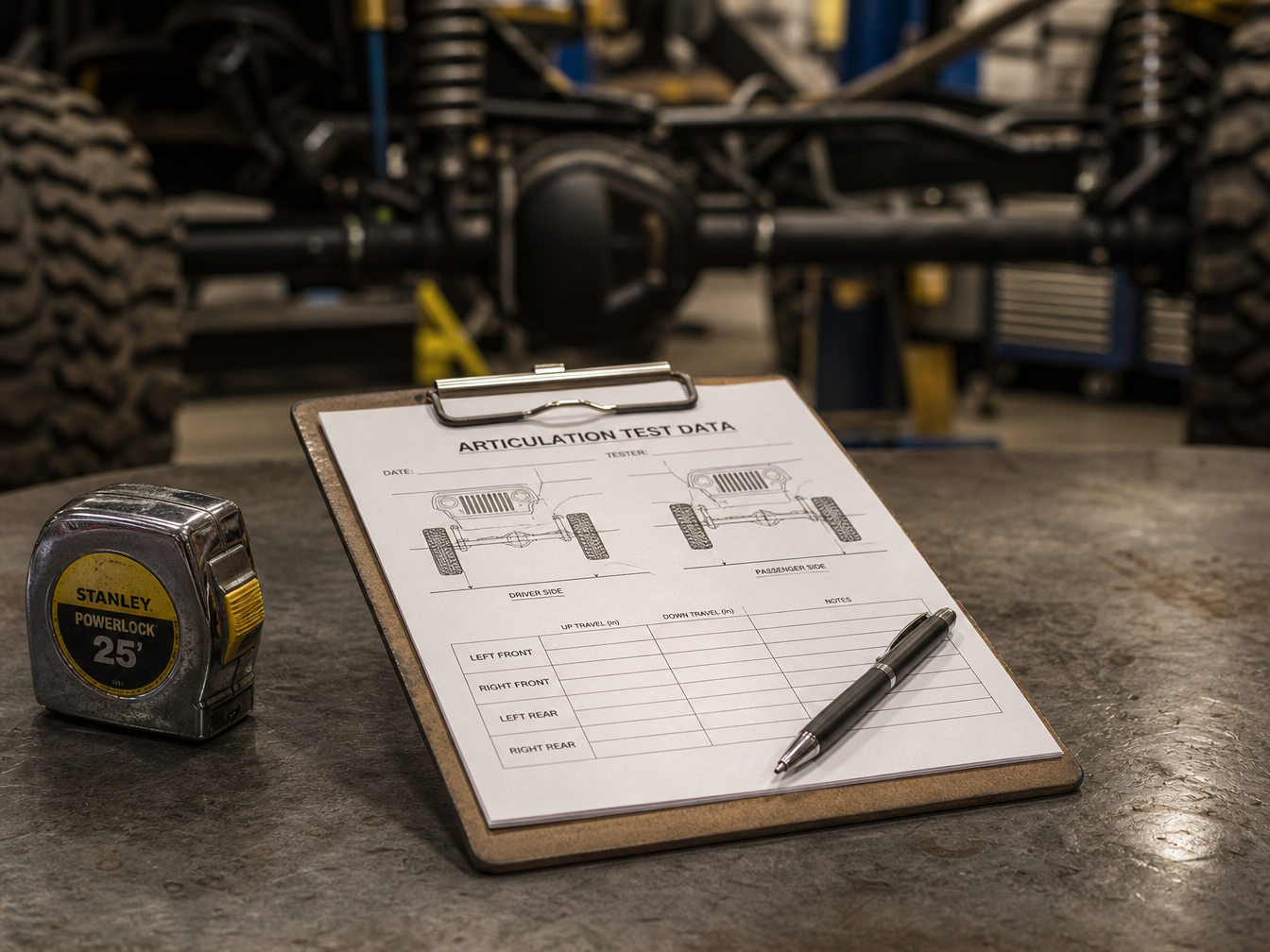
Written results document with your Jeep's RTI score, the scores at each test condition, comparison to platform baseline, and the identified limiters ranked by impact. You take this home. If you come back in six months after a suspension upgrade, we retest and show you the before-and-after comparison in writing.
30-Min Builder Consult
Kevin or Marcus — the people who actually build Jeeps here, not a service advisor — walk you through the data, explain what each limiter is doing and what it would take to address it, and answer every question you have about your specific rig. No time pressure. This is the 30 minutes most owners wish they'd had before they bought the wrong suspension kit.
What Happens After the Session
The $150 covers the test, the data sheet, and the consultation — completely. No obligation to book any follow-on work. Some owners come in, get their score, learn they're already in the 700s with a simple sway bar disconnect they hadn't been using correctly, and leave with a different relationship to the Jeep they already have. That is a win.
For owners who identify a real gap between their current score and their use-case goal, the session produces a specific and prioritized recommendation: what to do first, what it costs, and what RTI improvement to expect from it. If that work leads to a build at Summit Jeep Works, the $150 is credited toward the build total. If it doesn't, you leave with a document that tells any shop exactly what your Jeep needs — and you can make an informed decision about where to take it. And if you want to feel what the end state is actually like before committing to anything, you can drive a built rig first.
Schedule Your Articulation Test
Sessions are 90 minutes total — 30 minutes for the ramp test and data collection, 30 minutes for the debrief, and 30 minutes of buffer for any follow-up questions or physical inspection of specific limiters on the lift. Tell us about your Jeep and we'll confirm availability within the hour.
Book My Articulation Test
Tell us about your Jeep and what you're hoping to learn — we'll respond in under 30 seconds during shop hours.
Articulation Test Questions. Answered.
The questions we get before every session. If yours isn't here, it'll get answered in the first five minutes of your debrief.
Houston, TX 77057
Sat 9am–4pm