Custom Jeep
Fabrication
in Houston, TX
The aftermarket catalog eventually stops having answers. When it does, we build the solution from raw steel in the same building where we install it.
Tube bumpers to control arms. Skid systems to cage tie-ins. Aluminum fuel cells to chromoly suspension links. Every piece of metal that goes on your Jeep can be custom-made to your exact build by the same shop that's doing the suspension, the axles, and the wiring. Custom metal fabrication with MIG, TIG, and plasma cutting — all in-house at Summit Jeep Works in Houston.
When the Jeep Aftermarket Catalog Ends, We Start
Most shops that say "we fabricate" mean they farm it out. A custom bumper quote goes to a partner shop, comes back in two weeks with a markup, and gets bolted on without a fitment test on the actual vehicle. That is not fabrication — that is middleman work. At Summit Jeep Works, fabrication happens in the same building where the rest of your Jeep is being built. Same floor. Same crew. Same accountability.
Marcus Webb runs our fab bench. He spent six years at a custom fabrication shop in Austin before joining Summit Jeep Works — building tube bumpers, rock sliders, cage work, and custom suspension components for some of the most aggressive Jeep builds in Central Texas. He does not install catalog parts and call it fabrication. He cuts, bends, fits, and welds — then does a dry fit on your actual Jeep before a final weld touches anything. This is the difference between a part that fits correctly and a part that a customer accepts because the gaps are small enough to live with.
In-house fabrication also changes the build timeline. When the solution to your fitment problem is a custom bracket, we don't wait two weeks for an outside shop to turn it around — we make it the same day. When a customer's XJ unibody needs a non-standard stiffener run because their chassis has prior repair welds in the wrong places, we assess it, design the correction, and execute it in the same visit. Speed and accountability are the same thing when the fabricator is also the installer.
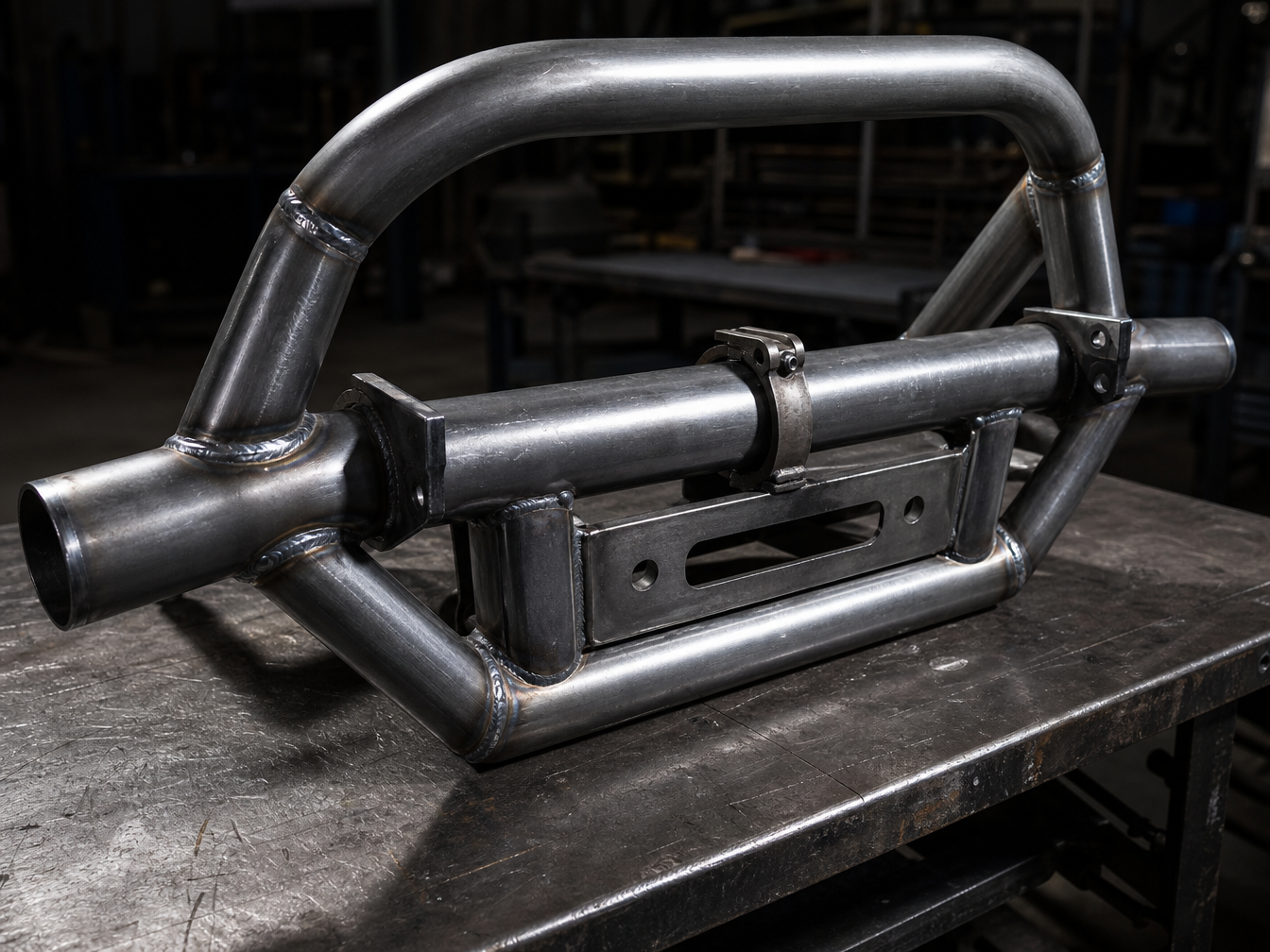
6 years at a dedicated custom fab shop in Austin before joining Summit Jeep Works. Tube bumpers, cage work, custom suspension links, XJ stiffener packages, and one-off bracket solutions. Every custom piece gets a dry fit on your actual Jeep before a final weld goes in. He also runs a Stage 3 JK on 37" Maxxis TREPADORS — built by his own hands.
Six Categories. One In-House Shop.
From the front bumper to the rear swing-out, from skid plates to suspension links — every piece of custom metalwork on this list is fabricated and installed in-house at Summit Jeep Works.
Tube Bumpers
Front and rear tube bumpers fabricated in-house from 2" DOM tubing. Stubby, full-width, mid-width, and custom configurations. Winch mounts, light tabs, D-ring mounts, and fairlead plates integrated at fabrication — not bolted on as afterthoughts. Every front bumper gets a fitment check on the actual Jeep before final weld.
- Single-tube and double-tube front designs
- Full-width, mid-width, stubby configurations
- Integrated winch plate (Warn, Smittybilt, ZEON spec)
- D-ring and recovery point mounts
- Rear bumpers with swing-out tire carrier
- Integrated Hi-lift and accessory mounts
- Bed liner or powder coat finish standard
Armor & Skid Systems
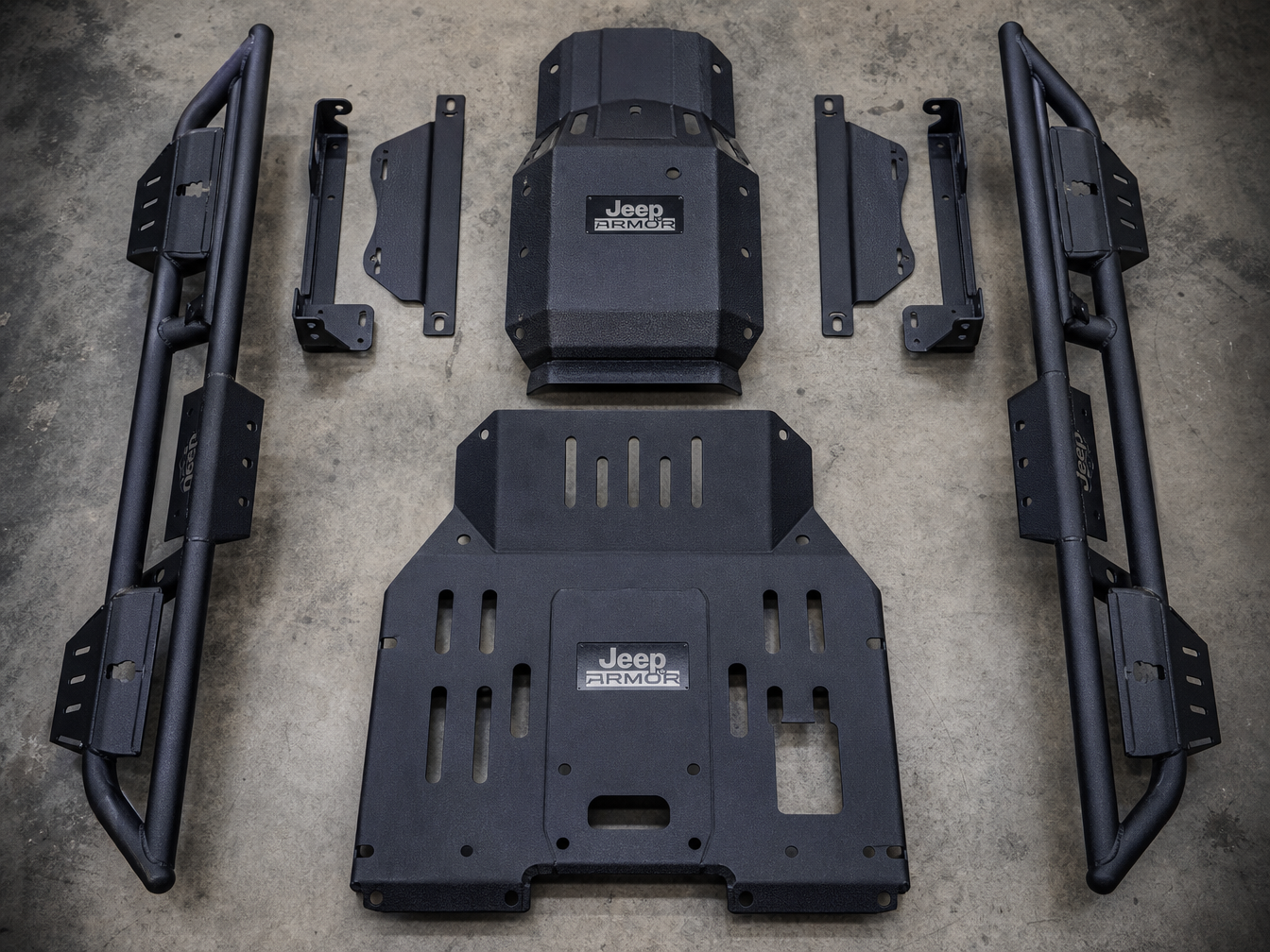
Full underbody armor from 3/16" or 1/4" plate steel — transmission skid, transfer case skid, fuel tank skid, and differential covers. Fabricated to the specific drivetrain configuration of your Jeep, not to a catalog fitment that assumes factory components. Essential before any Stage 2+ trail or rock work.
- Transmission and transfer case skids
- Fuel tank skid plates
- Differential covers (front and rear)
- Oil pan and steering skids
- Custom coverage for swapped drivetrains
- Integrated mounting for upgraded crossmembers
- Rust-inhibitor prep and bed liner standard
Rock Sliders
Weld-on rock sliders in DOM tube steel, fabricated to the exact rocker geometry of your platform and trim. Step-in tube configurations for tall-lifted JKs and JLs where ground clearance is priority, or full nerf configurations for trail rigs that need a combination of protection and step. Custom tube patterns for non-standard fender and body configurations.
- Weld-on DOM tube sliders (2" and 1.75")
- Step-in and step-over configurations
- Frame-tie options for structural connection
- JK / JL / XJ / TJ specific fitment
- Bed liner finish standard
- Custom builds for non-standard body configurations
Control Arms & Suspension Links
Custom-length DOM or 4130 chromoly control arms and suspension links for long-arm, four-link, and custom suspension builds. We fabricate to the exact geometry requirement of your build — correct length, correct wall thickness, correct end fitting spec for the load and articulation angle. Links are magnetic particle inspected on request for competition builds.
- Custom-length front and rear control arms
- DOM steel and 4130 chromoly options
- Johnny Joint and spherical rod end fitment
- 4-link upper and lower links
- Panhard bar / track bar replacements
- Correct geometry calculated before fab
- Anodized or powder coat finish available
Roll Cage & Cage Tie-Ins
Frame-tied roll cage work in 1.75" and 2" thick-wall DOM tube. Cage tie-in kits that sandwich the floor with steel plates and run structural tube to the frame rails — correctly. Bolt-in cages punch through floors in real rollovers. A properly executed weld-in cage with frame tie-in routes rollover forces into the chassis where they belong. XJ unibody stiffener integration required before serious cage work on Cherokee builds.
- Weld-in DOM roll cage (1.75" and 2" tube)
- Frame tie-in kits with floor sandwich plates
- Polyurethane-isolated cabin mounts
- Exo cage / half cage configurations
- XJ unibody stiffeners (prerequisite for XJ cage work)
- Competition-specification cage layout on request
Custom Brackets & One-Off Solutions
The work that doesn't fit a category. A swing-out spare tire carrier that clears your aftermarket bumper. A Hi-lift mount where the factory position doesn't work with your custom tube. A crossmember for a transmission swap that doesn't have an aftermarket solution. A set of underbody mounts for a relocated fuel cell. Whatever the problem, the fab bench makes the solution.
- Swing-out tire and gear carriers
- Hi-lift, Rotopax, shovel, and recovery mounts
- Transmission crossmember adapters
- Custom fuel cell mounts and brackets
- Roof rack rails and platform mounts
- Driveshaft safety loops
- Any fitment problem the catalog doesn't solve
Steel, Aluminum, Stainless — What Each One Is For
Material selection is not a style choice — it is an engineering decision based on load, weight, heat, and corrosion exposure. Here is how we select materials for every fabrication job.
The standard for bumper tube, cage tube, rock sliders, and structural suspension links. DOM steel has a consistent wall thickness and no seam — critical for structural tubing where a seam weld creates a stress concentration point. We run 1.75" and 2" DOM for cage work, 2" DOM for bumpers, and 1.5" DOM for slider tube.
Cold-rolled DOM is weldable with both MIG and TIG, holds paint and bed liner well, and is the most economical high-strength option for structural automotive fabrication.
4130 chromoly is the correct material for high-stress suspension links, control arms that will see competition-level articulation loads, and cage components on dedicated rock crawlers or competition builds. It is significantly stronger than mild steel at the same wall thickness — which means lighter parts at the same strength rating.
4130 requires TIG welding with pre-heat on heavier wall sections. We use it on Stage 3 suspension link fabrication, competition cage builds, and any control arm that will see sustained high-articulation loads at 40"+ tires.
Aluminum is the material for fuel cells, auxiliary storage tanks, underbody armor where weight reduction justifies higher material cost, and brackets that will never see direct impact loads. 6061-T6 is the most common aircraft-grade structural aluminum — heat-treated to T6 specification for maximum strength before machining or fabrication.
We TIG weld aluminum for fuel cells and tank fabrication. 6061 anodizes well for corrosion protection in Houston humidity. It is not the correct material for anything that takes impact — rock sliders, bumper tube, and cage work stay in steel.
304 stainless is used for exhaust components, heat shields, and any application where high temperature cycles and corrosion exposure are simultaneous concerns. It maintains structural integrity at significantly higher temperatures than mild steel and resists the rust that eats through mild steel exhaust headers inside three to five Texas rainy seasons.
TIG welding only on stainless — MIG welds on stainless have porosity issues that compromise corrosion resistance at the weld point. We TIG all stainless work at full penetration and back-purge exhaust components during welding.
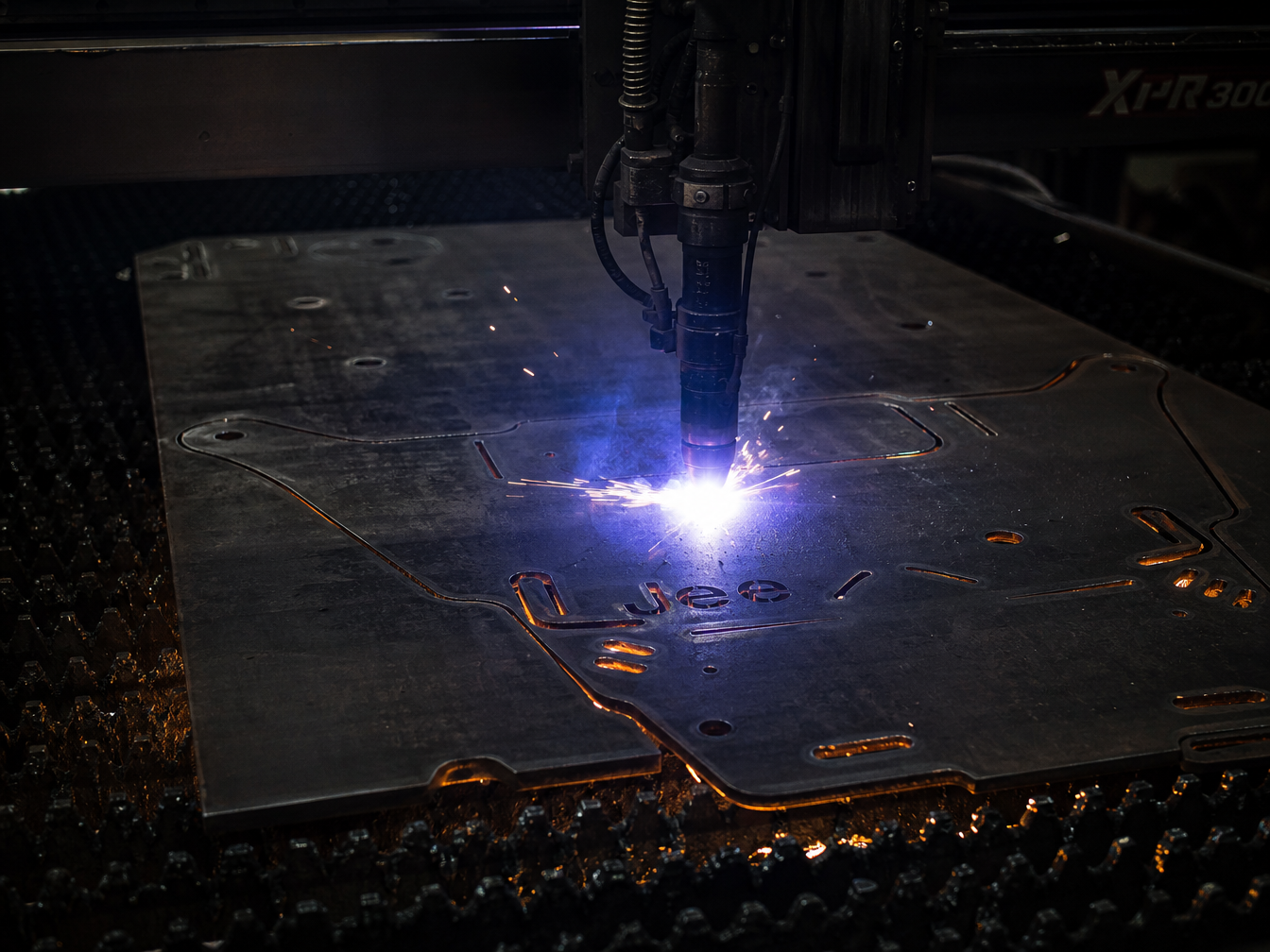
Skid plates, gusset plates, unibody stiffeners, and armor panels are cut from flat cold-rolled steel plate — 3/16" for moderate applications, 1/4" for primary skid protection and any armor that takes regular direct rock contact. Flat plate is plasma-cut to precise shapes on our CNC table, then formed, fitted, and welded.
Every flat plate armor piece goes through the same finishing process as our tube work: rust-inhibitor primer to bare steel, then bed liner or powder coat. Raw steel in Houston humidity is oxidized steel in six months regardless of how thick the plate is.
Lightweight panel work — battery box enclosures, custom interior storage panels, underbody heat shields for diesel builds, and thin mounting plates where mild steel sheet is appropriate. 18-gauge for lightweight panels, 16-gauge for anything that sees light impact, 11-gauge for structural panel applications like firewall patches and floor reinforcement plates.
Sheet work is where TIG welding earns its place on non-structural pieces — the cleaner bead profile is visible and the lower heat input prevents warping thin material.
Plasma, MIG, and TIG — The Right Tool for the Work
Three processes. Each one has a specific application where it outperforms the others. We use all three — and we use the right one for each job.
Plasma Cutting
Plasma cutting is how flat steel becomes precise shapes. Our CNC plasma table cuts skid plates, gusset plates, stiffener panels, and armor pieces to dimensional tolerance that a hand torch cannot achieve. The table reads a DXF file and cuts the part — which means the part that gets welded to your Jeep was designed on a screen, verified against your platform's geometry, and cut to that verified design. Not approximated with a grinder and a steady hand.
Plasma-cut edges require cleanup (slag removal, edge conditioning) before welding. We do this as standard — plasma-cut edges that aren't cleaned produce porous welds at the joint. Every part that comes off the plasma table gets edge prep before it sees a MIG or TIG.
MIG Welding
MIG welding is the standard for structural fabrication — bumper tube, rock sliders, skid plate brackets, suspension mount plates, and anything where high deposition rate and consistent penetration matter more than aesthetic bead profile. Our Miller 211 runs solid wire with C25 gas (75% argon, 25% CO2) for general mild steel structural work.
Structural MIG welds are inspected for proper fusion, correct throat size, and absence of porosity before any part goes into fit-up on the vehicle. We do not inspect welds with the part already bolted in place — welds get checked before installation, while they're still accessible from all angles.
TIG Welding
TIG welding is slower, requires more skill, and produces a cleaner, more controlled bead profile than MIG at comparable settings. We use TIG for aluminum (where MIG produces porosity issues), stainless steel (where MIG welds compromise corrosion resistance at the bead), 4130 chromoly structural components, and any visible weld on a finished piece where the bead profile is part of the presentation.
TIG on aluminum requires a dedicated AC TIG welder with high-frequency start. Stainless TIG requires back-purge on hollow sections during welding to prevent oxidation inside the tube. Both are standard procedure at our bench — not special requests.
Finishing: No Bare Steel Leaves This Shop
The fabrication work ends at the weld. The finishing work is what makes it last. Every custom piece that leaves Summit Jeep Works goes through the same sequence: slag removal and weld cleanup, wire brush or angle grinder to remove scale and mill skin from all surfaces, application of rust-inhibiting primer to bare steel, and final finish in bed liner or powder coat to the customer's spec.
In Houston, bare steel is not a temporary condition before the clear coat goes on — it is rust in progress. The combination of rainfall frequency, summer humidity, and the salt content in Gulf Coast air makes any unprotected steel surface active within weeks of installation. We prime and topcoat every piece because we live here and we understand what the climate does to unprotected metal.
For pieces that require a specific aesthetic — polished stainless, anodized aluminum, color-matched powder coat — we work with local finishing shops who can execute the surface treatment to spec. We do not do the full powder coat line in-house. What we do in-house is all prep work and the structural rust-inhibiting primer that goes under any topcoat, because that is the coat that actually protects the steel.
When Catalog Parts Work — and When They Don't
We are not anti-catalog. ShrockWorks, Metalcloak, Poison Spyder, C4 Fabrication, and GenRight make excellent parts that fit correctly and perform well. When the catalog has the right answer, we use it. Here is the honest map of when custom fab is the correct call.
| Scenario | Catalog Part | Custom Fab |
|---|---|---|
| Standard JK/JL tube bumper, factory frame | Correct call — catalog fits, warranty included | Not needed |
| JK/JL with prior bumper damage or frame modification | May not fit correctly | Custom fab to actual dimensions |
| XJ Cherokee rock sliders, standard trim | GenRight or ShrockWorks fits well | Not needed at Stage 1–2 |
| XJ with non-standard body mounts or unibody repair | Fitment issues likely | Custom fit to your specific chassis |
| Stage 2 suspension on standard platform | Catalog control arms (Metalcloak, Currie) | Not needed unless custom geometry spec |
| Stage 3 / four-link / custom geometry build | Catalog length may not match geometry | Fabricated to exact spec |
| Roll cage on stock-floor Wrangler | Bolt-in cages not adequate for real rollover | Weld-in cage with frame tie-in only |
| Drivetrain swap requiring new crossmember | Rarely exists in catalog | Custom crossmember fabricated to fit |
| Rear swing-out with specific tire/gear carrier spec | Off-the-shelf designs may not clear your build | Custom swing-out to actual clearance envelope |
Custom Fabrication Questions, Answered
Questions we get before every custom fab project. If yours isn't here, bring the Jeep in and we'll answer it on the rack.
Custom Fabrication for Jeep Owners Across Greater Houston
Summit Jeep Works fabricates and installs custom metalwork for Wrangler, Cherokee, and Gladiator owners from across the Houston metro.
Houston, TX 77057
Sat 9am–4pm