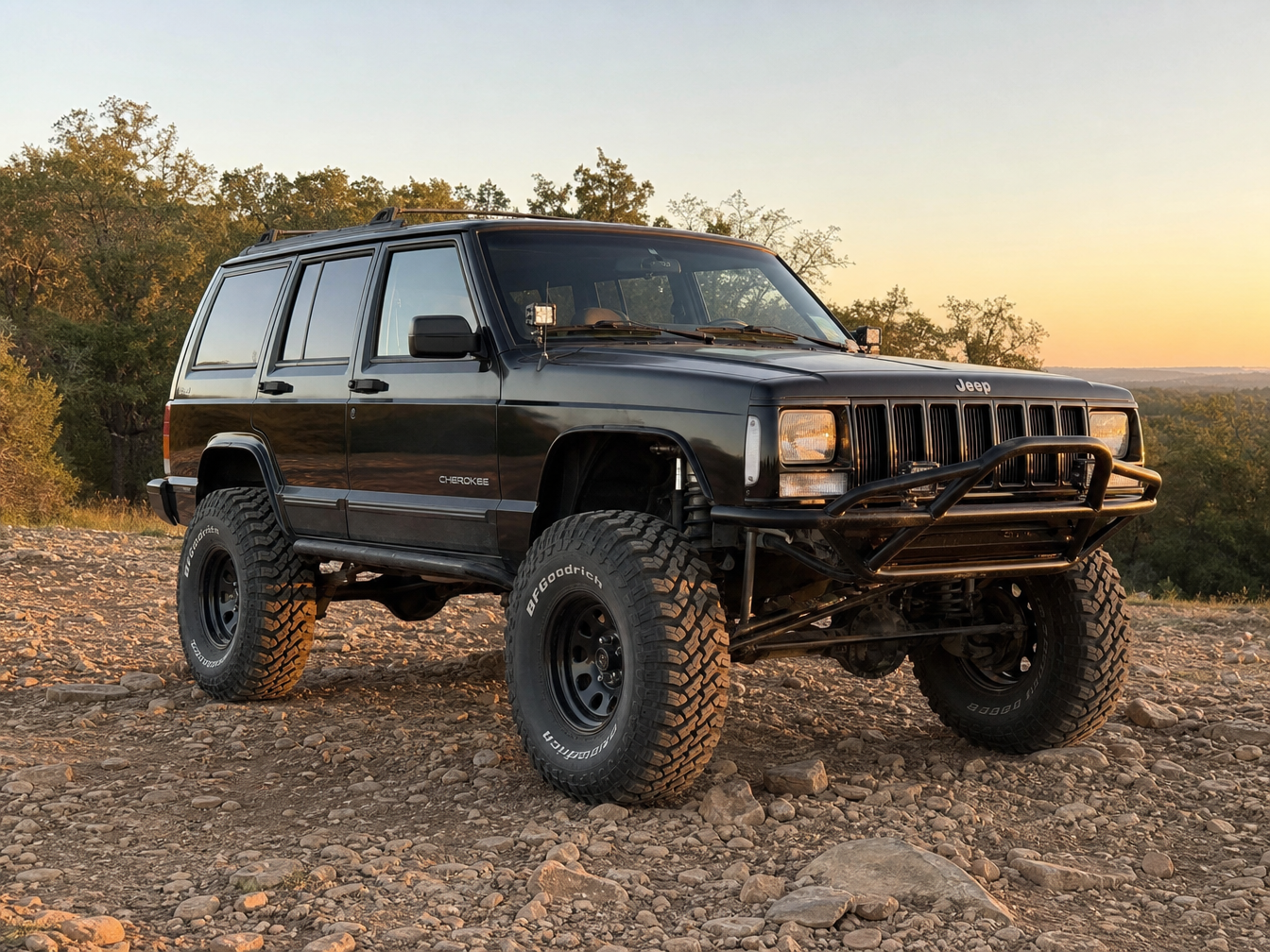
The Cherokee Earned Its Reputation. We Build Toward It.
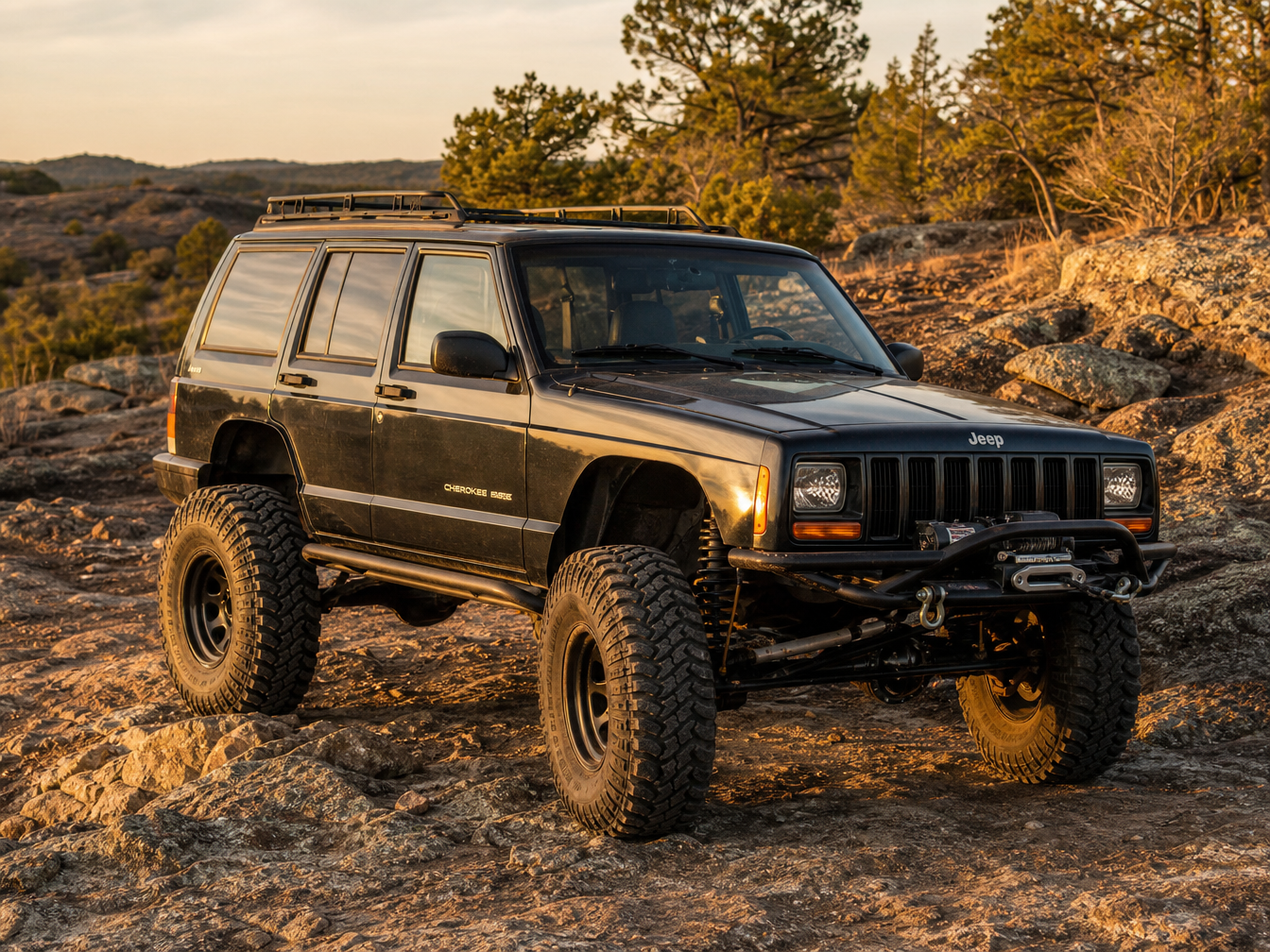
The XJ Cherokee ran from 1984 to 2001 — seventeen years, millions of units, and an aftermarket that's still expanding in 2026. It was the first mass-production 4x4 to use unibody construction at scale, and that single engineering decision is what makes it so capable on technical terrain. Without the body-on-frame weight penalty, the XJ flexes differently, recovers differently, and carries its modifications differently than any Jeep built before or after it.
That same unibody is also what kills XJs in the hands of shops that don't know the platform. Rust inspection on a unibody isn't optional — it's the entire pre-purchase conversation. Axle upgrades on an XJ aren't cosmetic — the Dana 35 rear is a known failure point that defines the build roadmap from Stage 1 forward. Lift geometry on an XJ isn't the same as a JK — the slip yoke situation on the NP231 transfer case is a detail that changes the entire suspension spec.
We don't build XJs occasionally. We build them intentionally. The platform knowledge is deep here — and every assessment we do on a Cherokee starts from the same foundation: we know what broke before you got here, and we know where it's going to go next if you build it wrong.
XJ Cherokee Specs — What You're Actually Working With
Before any build starts, the platform facts matter. Here's the XJ by the numbers — production years, engine configurations, axle stacks, and what each combination means for your build.
Production: 1984–2001 · 17 years · Unibody construction
Engine Configurations
| Engine | Years | Displacement / Output | Build Notes |
|---|---|---|---|
| 2.5L I4 | 1984–2001 | 150 hp | Base engine — adequate for mild daily use; not a build foundation |
| 4.0L I6 | 1987–2001 | 190 hp | The engine the XJ was built around. Torquey, bulletproof with maintenance, enormous aftermarket |
| 2.1L Turbodiesel | Select years | — | European market only — not a US build target |
Our recommendation: 4.0L I6 only for any serious build. The 4.0L is not just the better engine — it's the engine every XJ aftermarket part is sized and tuned around. Starting with a 2.5L I4 is starting with the wrong foundation.
Axle & Drivetrain Stack
| Position | Axle / Component | Fitment | Build Significance |
|---|---|---|---|
| Front | Dana 30 | All XJ models | Adequate to 33" tires with mild wheeling — upgrade path exists for Stage 2+ |
| Rear | Dana 35 | Most XJ models | "The Can Opener" — documented failure above 33" on aggressive terrain. Stage 2 upgrade target |
| Rear | Dana 44 | Select late-model (some 2001s) | Desirable — commands purchase premium; skips one major upgrade step |
| Transfer Case | NP231 Command-Trac | Most common | Two-speed, part-time 4WD — requires SYE when lifted above 3" |
| Transfer Case | NP242 Select-Trac | Select models | Full-time 4WD option — more versatile for mixed daily driving conditions |
Trim guidance: Four-door XJs dominate the build community for their wheelbase length and practicality. The parts ecosystem — sliders, rock rails, interior cargo builds — skews heavily toward the four-door. We build both. Four-door is the easier spec conversation.
The Failure Points Every XJ Owner Encounters.
These aren't edge cases — they're predictable events in the XJ ownership timeline. Every shop that actually knows the platform can call these before they happen. Here's our honest breakdown of each one, what causes it, and how we address it.
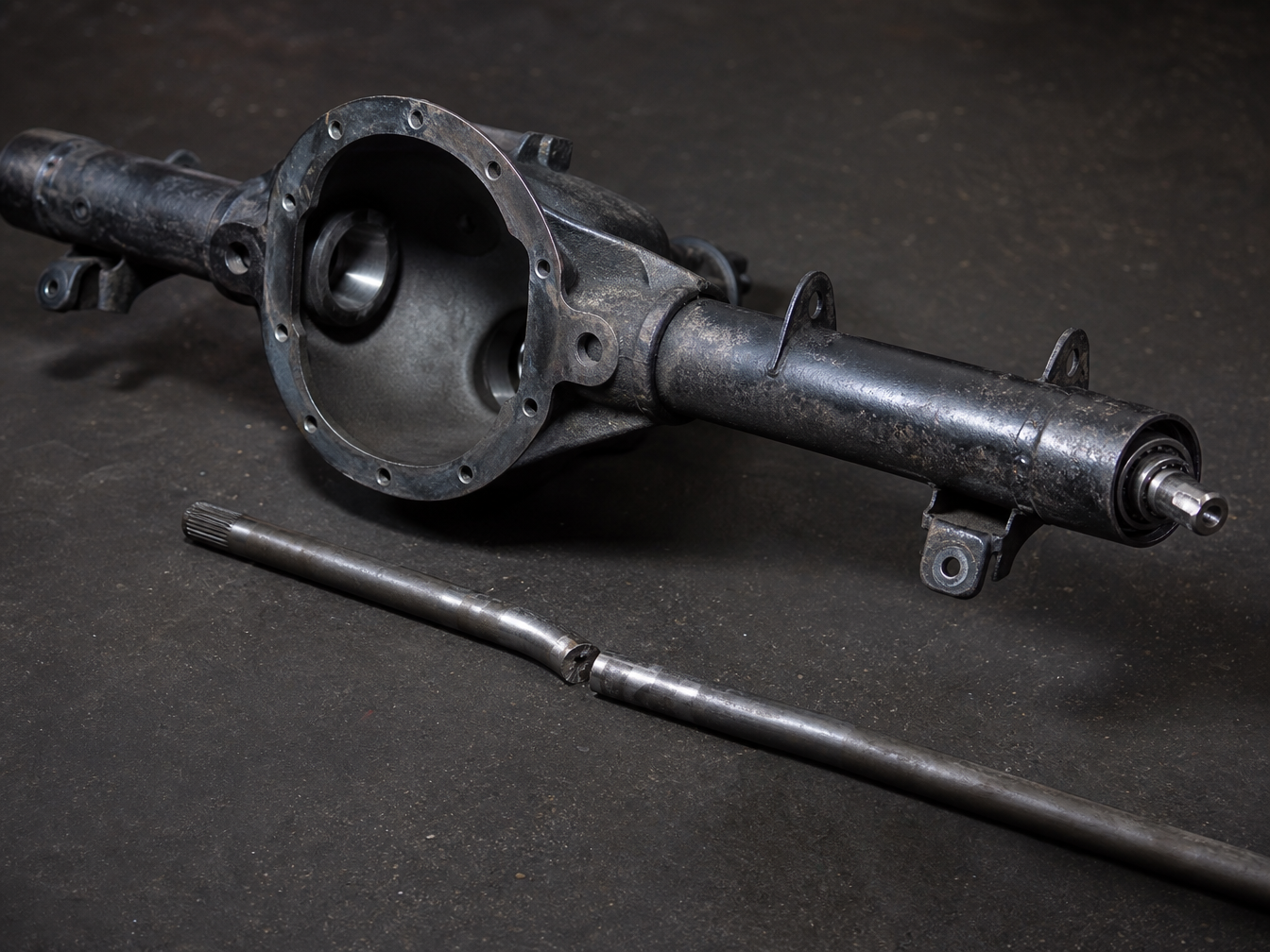
The C-clip axle shaft design allows the axle to fold inward on a hard hit rather than staying put. Under aggressive trail use — especially with 33"+ tires — the Dana 35 rear axle is not a question of if it breaks. It's a question of when. Lockers accelerate the timeline.
What we do: Dana 35 with a TrueTrac locker and Alloy USA shafts for mild builds that won't see serious rock. Dana 44 swap for any build going above 33" or running lockers hard. We'll tell you which camp your use case falls into at the assessment.
Dana 35 showing signs? Book a diagnosis →In a body-on-frame Jeep, rust attacks the frame. In an XJ, rust attacks everything simultaneously — because the body IS the structure. Age, poor drainage design in the floor pan corners, and XJs that spent time in wet climates before reaching Texas all contribute.
What we do: Complete pre-build rust inspection on every XJ we assess. We pull carpet, check the floor pan corners, inspect the firewall, check the rear wheel wells, and inspect every seam. If the unibody is compromised past the point of structural repair, we say so before you spend build money on a rig that can't support it.
Concerned about rust before buying? Come in first →An XJ that randomly dies at speed, sometimes restarts, sometimes leaves you stranded — and throws no obvious codes — is almost always a failing CPS. Heat cycling and age put this sensor in the wear category on every high-mileage 4.0L.
What we do: Replace proactively on any XJ coming in for a build assessment with high mileage or intermittent stall history. A $30 part that prevents a tow bill and a missed trail day.
The NP231's slip yoke output creates an acceptable rear driveshaft angle at stock ride height. Add 3"+ of lift and the angle becomes severe enough to cause vibration at highway speed, accelerated U-joint wear, and eventual driveshaft failure. Most discount lift shops leave this out of the quote.
What we do: Every XJ build above 3" includes an SYE kit and CV-style rear driveshaft in the quote. Not optional. Not a budget cut. This is the item that explains most of the "why does my XJ vibrate at 65 mph" calls we get from other shops' customers.
Already lifted and feeling vibration? Book a drivetrain assessment →The 4.0L I6 is legendary for durability — and legendary for finding ways to leak oil as it ages. Rear main seal, valve cover gasket, and oil pan gasket on a 20+ year old engine are simply due. Rare is the well-used XJ that doesn't show some evidence of oil loss.
What we do: Address oil leak sources as part of any major build access. If we're pulling the engine or drivetrain for a build, we replace the seals while we have access — because the alternative is a second disassembly later at full labor cost.
The 1999–2001 4.0L used a revised head casting with documented increased head gasket failure rates compared to earlier production years. The revised casting runs slightly hotter under load. Overheating events — even minor ones — accelerate the failure timeline.
What we do: Late-model XJ assessments include a coolant inspection, compression test, and check for the telltale white exhaust and milky oil. If it's going, we address it before the build — because an undetected head gasket issue kills a build budget fast.
Why the XJ Still Runs at the Front of Every Trail.
The XJ Cherokee hasn't been in production since 2001. You can't buy one new. There's no dealer support, no factory warranty, and no official Jeep parts pipeline. And yet — in 2026, the XJ Cherokee is still the most commonly built compact Jeep in the off-road community. That's not nostalgia. That's a verdict.
The 4.0L I6 is still regarded by most serious builders as the best factory engine ever installed in a compact 4x4. Not because it's powerful by modern standards — it isn't — but because of what it does with that power in the conditions where XJs operate. Low-end torque that moves the Jeep predictably over obstacles. A flat torque curve that doesn't demand rev-matching in low-traction situations. Durability that survives the kind of abuse that destroys modern engine management systems. And an aftermarket that treats it like a platform, not a curiosity.
The unibody construction — the same feature that made the XJ polarizing when it launched — is now understood as the reason it outperforms contemporary body-on-frame 4x4s in technical terrain. Less unsprung weight. Better flex transfer. A tighter overall package that fits lines trucks can't touch.
The XJ community is also the most self-sufficient community in Jeep culture. XJ owners do more research, carry more recovery gear, and demand more from their builds than most other platform communities. When an XJ owner walks into Summit Jeep Works, they usually know more about their specific platform than most shops that worked on it. We know that.
It's why we take the technical conversation seriously from the first minute. We're not here to educate you about your XJ. We're here to build it. The finished XJs in our build gallery are the proof.
Looking for an XJ Cherokee specialist in Houston TX? Summit Jeep Works has been building XJ Cherokees in Houston since 2014. Call (713) 555-0140 or walk in — no appointment needed.
If You're Buying an XJ, Here's What We'd Look For.
This section is for people who haven't bought yet. If you're committed to the platform and actively shopping — read this before you pull the trigger. We've seen enough post-purchase surprises to know what this conversation is worth.
Target Years
The 1997–2000 XJ is the sweet spot for most builders — after the early production quality issues, before the 1999–2001 revised head casting concerns on the 4.0L. A well-maintained 1997–1999 4.0L is the cleanest foundation. The 2001 model year — the final year — is desirable for its revised equipment, but demands a full head gasket assessment before purchase.
Target Configuration
Four-door · 4.0L I6 · NP242 Select-Trac · Dana 44 rear axle where available. This combination skips the rear axle upgrade at Stage 2, gives you full-time 4WD versatility, and doesn't compromise on the engine. These rigs command a premium. They're worth it.
What to Avoid
- Rust belt XJs (Ohio, Michigan, New York, Pennsylvania) without a complete unibody inspection
- 2.5L I4 engines for any build with trail intent — the aftermarket wasn't built around it
- Rebuilt title vehicles without clear documentation of what was repaired
- Low-asking-price XJs ($1,500–$3,000) without a thorough walkthrough — the savings are rarely real after the first shop visit
Pre-Purchase Checklist
- Floor pan corners — front footwells and rear cargo area. Tap the floor. It should sound solid, not hollow
- Frame rails along the pinch welds where the body folds under
- Rear wheel wells — XJs accumulate rust behind the rear wheels
- Oil condition — milky oil means head gasket concern
- Coolant condition — rusty coolant means cooling system neglect
- Power steering reservoir — brown or burnt fluid means component wear
- NVH at highway speed — slip yoke vibration if previously lifted
- 4WD engagement — both high and low, and both ranges if equipped with NP242
- Front end shimmy — steering component wear or alignment
Buying an XJ and want a second opinion? We do pre-purchase inspections. Walk in before you buy.
What Each Lift Height Unlocks on the XJ Cherokee
| Configuration | Max Tire (Clean) | Notes |
|---|---|---|
| Stock | 29"–30" | Extremely tight — factory tires already close to the limits at full lock |
| 2" body lift only | 31" | Raises body only, not suspension geometry — no drivetrain benefit |
| 2.5"–3" suspension lift | 31"–32" | Entry range — minor geometry correction needed. Most short-arm kits target this range |
| 3.5"–4" suspension lift | 33" | The XJ sweet spot. Clears 33s well with correct offset. Standard XJ trail build target |
| 4.5"–6" long-arm | 33"–35" | Requires SYE, CV driveshaft, extended brake lines, and caster correction — mandatory |
| 6"+ long-arm custom | 35"–37" | Full build territory — complete geometry correction, modified mounts, custom fabrication required |
Rubbing Callouts
At 33" on a 3.5"–4" lift: minor trimming of the inner fender lip typically required at full bump travel. At 35"+: full fender trimming (inner and outer), SYE mandatory, and longer front brake lines standard.
Offset guidance: XJ wheel offset sits around +25mm to +44mm stock. A -6mm to +18mm aftermarket offset is the typical target for 33" builds — enough to clear suspension components and fill the wheel well without excessive poke.
Why 33" on 4" Is the XJ Standard
The XJ community converged on the 33"/4" combination decades ago for good reason: it's the point where the platform gains serious capability without requiring the full axle and drivetrain investment of a 35" build. A well-built 33" XJ on a 4" lift handles 95% of what Houston-area Jeep owners trail on. The 35" build is for the other 5% — and for owners who know they're committed to it from the start.
The Lift Kits We Run on XJ Builds — and Why
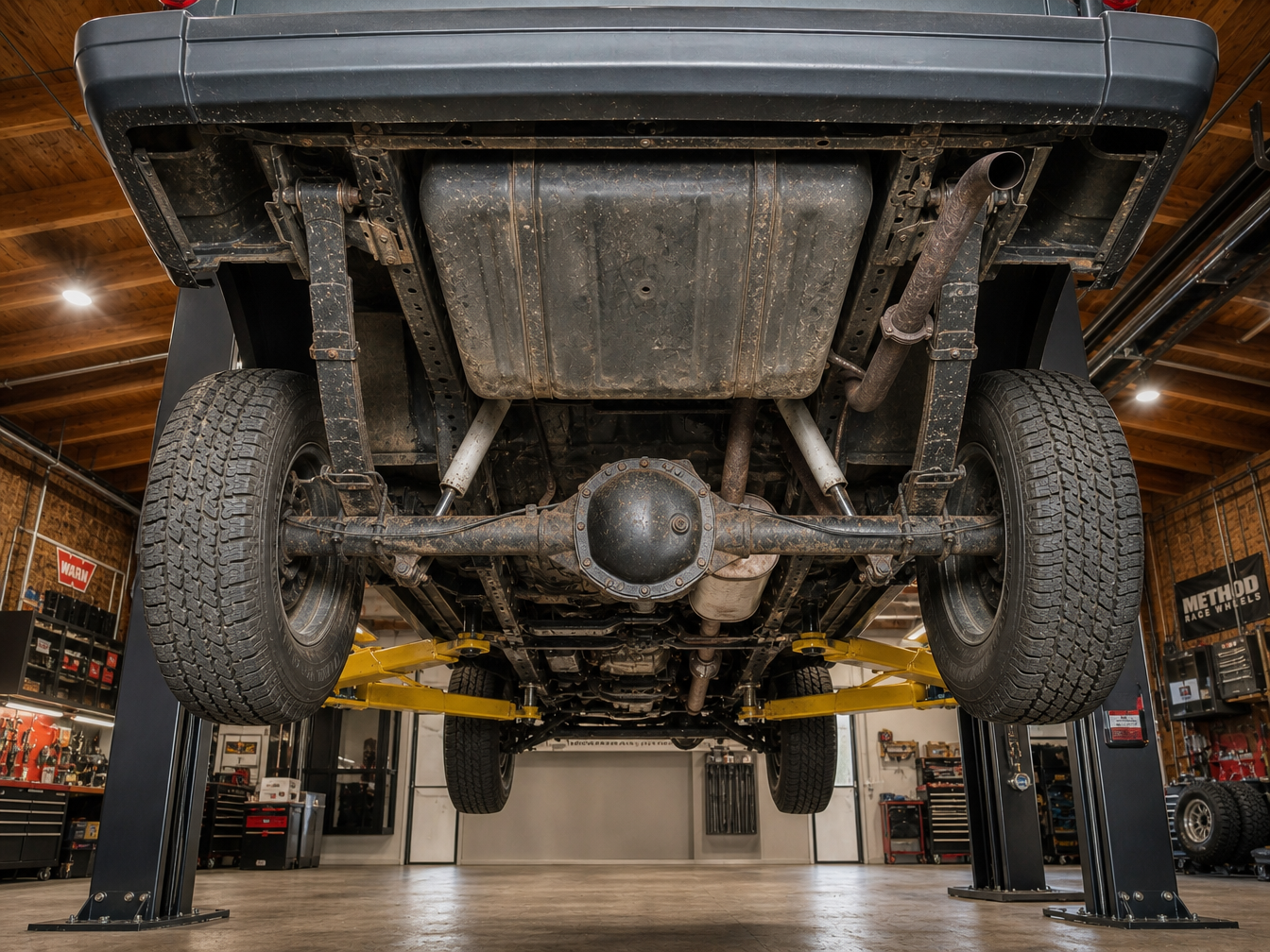
The XJ's unibody construction means control arm geometry at lift matters more than on body-on-frame Jeeps. A lift that works on a JK won't transfer directly to an XJ — the mounting points, the factory caster angle, and the slip yoke situation are all XJ-specific considerations.
Short-Arm Kits (3.5"–4" — Stage 1 Builds)
Old Man Emu (OME) / Dobinsons — Our preferred short-arm recommendation for the XJ owner who daily drives and trails on weekends. Australian-engineered for load and terrain — the spring rates are honest and the ride quality on Houston's concrete panel roads is the best in the short-arm category. The shock quality holds up in Texas heat better than most alternatives.
Rubicon Express — Reliable short-arm kit at a fair price point. Good geometry for the Stage 1 XJ build. Lacks some of the tuneability of OME but is a clear step above the budget options and a legitimate choice for owners prioritizing value at Stage 1.
What we don't run: Rough Country on any XJ that sees serious trail use. The geometry doesn't correctly address caster at 4", and the shock quality doesn't survive Houston's roads for the long haul. We fix a lot of Rough Country installs. We don't do many Rough Country installs.
Long-Arm Kits (4.5"–6" — Stage 2 and Above)
Currie Enterprises — Our top recommendation for long-arm XJ builds. The geometry is correct, the fabrication quality is serious, and it's one of the few long-arm systems that addresses the unibody mount reinforcement correctly. If you're going long-arm, Currie is the conversation we want to have first.
TeraFlex — Reliable long-arm option for the XJ. More accessible price point than Currie with solid geometry. A reasonable alternative for Stage 2 builds where the budget is being allocated heavily toward the axle swap and lockers.
TNT Customs / Rusty's Off-Road — Well-regarded in the XJ community for budget-conscious long-arm builds. Requires careful attention to caster correction and driveshaft angles — not a set-and-forget install. We do these correctly when the budget calls for it.
We include the following on every XJ lift we install regardless of kit brand: SYE and CV rear driveshaft on any lift above 3", extended front and rear brake lines, 4-wheel alignment, and caster verification on the rack before delivery.
Best-in-Class Aftermarket Parts for the XJ Cherokee
Category-by-category breakdown of what we run and recommend on XJ builds. These are opinions with reasons — not a parts catalog. Platform-specific fitment notes where they change the recommendation.
Suspension
Long-arm lift kit (Currie, TeraFlex) · OME or Dobinsons springs · Adjustable upper control arms · Track bar relocation bracket · Extended sway bar end links · Coilover conversion for Stage 3
SJW note: We don't carry every kit on the market — we carry the ones that work for how Houston-area XJ owners actually drive. If you show up with a Rough Country kit in a box, we'll tell you why we'd recommend something different before we install it.
Axle & Drivetrain
Dana 44 rear axle (swap or complete unit) · ARB Air Locker (preferred — rebuildable, reliable, adjustable) · TrueTrac (preferred locker for Dana 35 if staying) · Alloy USA chromoly axle shafts · SYE kit (Tom Woods or Adams Driveshaft) · CV rear driveshaft · High-steer conversion for front Dana 30 at lift
Armor & Recovery
Rock sliders — ShrockWorks and Rusty's are the XJ-specific benchmarks · Full belly skid system (engine, trans, t-case) · Rear bumper with swing-out and D-ring mounts · Front tube bumper with integrated winch mount · WARN winch (9,500 lb minimum for an XJ with full armor and gear)
Lighting
LED light bar (30"–42" roof mount, 20" for bumper) · Bumper-integrated pods · Rock lights at wheel wells · Fog light upgrades · All wired through factory firewall — no exposed harnesses on any Summit Jeep Works build
Wheels & Tires
15×8 or 16×8 steel wheels (the XJ community standard for trail durability) · 15×8 alloy where appearance matters · 33×12.50R15 BFG KM3 or KO2 (the most common XJ trail tire for good reason) · 33×12.50R15 Toyo MT at Stage 2 · Correct offset verified against your lift before any order
Electrical & Electronics
Dual battery setup (Stage 2 and above — essential with winch) · Viair onboard compressor (480C for serious trail use) · ARB compressor for integrated air locker control · Relay panel for auxiliary lighting circuits · HAM radio mount for remote trail runs
XJ Cherokee vs. TJ Wrangler vs. ZJ Grand Cherokee — Which One Is Right for You?
These are the three Jeep platforms from the same era that buyers most commonly compare. Honest framing on each — the XJ isn't right for everyone, and we'll tell you that directly.
| Factor | XJ Cherokee | TJ Wrangler | ZJ Grand Cherokee |
|---|---|---|---|
| Platform Type | Unibody | Body-on-frame | Body-on-frame |
| Best Years | 1997–2000 | 1997–2006 | 1993–1998 (ZJ) |
| Engine Sweet Spot | 4.0L I6 | 4.0L I6 | 4.0L I6 or 5.2L V8 |
| Trail Capability | High | Very High | Moderate (stock) |
| Daily Drivability | High | Moderate | High |
| Parts Availability | Excellent | Excellent | Good |
| Rust Vulnerability | High (unibody) | Moderate (frame) | Moderate (frame) |
| Stage 2 Cost | Higher (axle swap required) | Moderate (geometry, no axle swap) | Moderate (capable factory axles) |
| Community Size | Massive | Massive | Smaller but active |
| Recommended For | Trail-focused compact build | Most versatile trail/daily balance | Comfort + moderate trail |
When We'd Recommend the XJ
You want a compact trail vehicle with a massive aftermarket and you're committed to the platform for the long haul. The XJ rewards investment — every dollar spent builds on a chassis that the community has spent 40 years perfecting. If you're willing to address the Dana 35 at Stage 2 and treat the unibody with the respect it deserves, the XJ Cherokee is the most capable compact Jeep ever built.
When We'd Recommend the TJ Instead
You want more trail capability stock, you don't want to address a rear axle swap in your Stage 2 budget, or you want the topless/doorless trail experience as part of ownership. The TJ Wrangler's solid front and rear axles are both more capable than the XJ's Dana 30/35 stack at every stage.
When We'd Recommend the ZJ
You want a capable platform with more daily driver comfort, or you want the V8 option. The ZJ is underrated in the build community — not our specialty, but honest about its strengths.
Not sure which direction to go? Come in — we'll give you our honest take →XJ Cherokee Questions We Actually Get. Answered Completely.
Eight to ten questions we hear from XJ owners every week. Real answers — not deflections. If yours isn't here, come in and ask us in person.
Your XJ Deserves a Shop That Actually Knows It.
Most shops have worked on an XJ. Few shops have built them intentionally — with a documented understanding of the axle stack, the unibody failure modes, and the build sequence that separates an XJ that lasts from one that breaks at the worst time.
Summit Jeep Works starts every XJ assessment with the same question: where is this XJ right now, and where does it need to go? We'll look at your platform, map the gaps, and give you a build sequence that makes sense for your budget and your trail goals. The assessment is free. The conversation is straight.
Houston, TX 77057
Sat 9am–4pm