Why Jeeps.
Why We Only Build One Brand.
This is not a history of Jeep. This is why one Houston shop decided to build Jeeps exclusively — and why, after 12 years, we've never second-guessed it.
You could build anything. Tacomas, Broncos, Raptors. Plenty of demand, plenty of margin. We chose Jeeps. Not because of the brand — because of the platform, the mechanical argument, the community, and the simple fact that nothing else on the road asks as much of a shop while rewarding that expertise as consistently as a Jeep does. Here's the full case.
Solid Axles. Bulletproof Engines. Parts That Don't Lie to You.
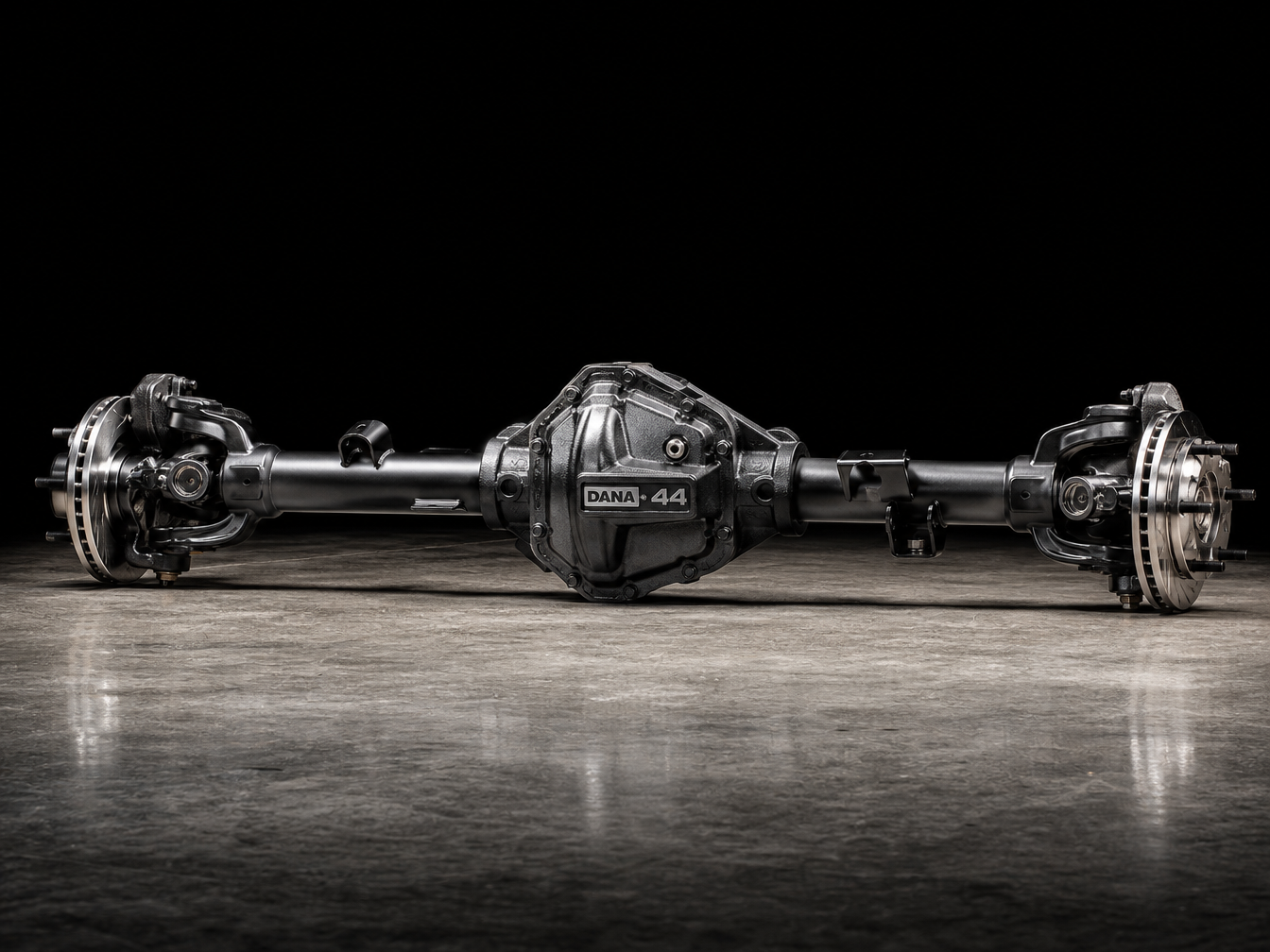
Start with what's under the Jeep. Every serious Wrangler, Cherokee, and Gladiator runs a solid front and rear axle. Not independent front suspension. Not a multi-link IRS rear that requires a specialized shop and a parts catalog that costs as much as the repair. A solid beam. Dana 30, Dana 35, Dana 44 — axle designs that have been in production, in use, and in the aftermarket catalog since the 1940s.
Solid axles do things that independent suspension physically cannot. They articulate uniformly — both wheels move together, so when the right wheel drops into a hole the left wheel doesn't torque the entire front subframe. They are repairable on a trail with a hammer, a press, and basic tools. They are upgradeable in a linear, predictable way: bigger housing, stronger shafts, better locker, done. And they are consistent — a Dana 44 from 1987 and a Dana 44 AdvanTEK from 2023 run the same gear ratios, the same locker mounts, the same basic architecture. The entire aftermarket built itself around this consistency.
Toyota's 4Runner runs independent front suspension. We understand why Toyota does it — IFS produces better on-road handling and a more comfortable highway ride for most buyers. But IFS limits articulation, requires more specialized rebuild work, and means the aftermarket is solving a harder problem for every lift kit. The 3rd generation 4Runner (1996–2002) was a good truck that competed directly with the XJ Cherokee. The XJ had a solid front axle, a 4.0L I6, a turning radius that put the 4Runner to shame, and cost a fraction to rebuild when something went wrong. The 4Runner had more road polish. The XJ had more substance under it. We know which one fills our bays.
The 4.0L I6 — The Engine That Earned the Reputation
The AMC-derived 4.0L inline-six was in production from 1987 to 2006. It powered the Cherokee XJ, the Wrangler TJ, and the Grand Cherokee ZJ and WJ. In 19 years it received incremental improvements — better fuel injection, improved head gaskets, revised intake — but the core architecture never fundamentally changed. That stability produced something rare in automotive engineering: a genuine reputation for indestructibility.
We are not being sentimental. The 4.0L earns 200,000 miles routinely. 300,000 is not unusual with basic maintenance. A friend of the shop runs a 2001 Cherokee XJ with 340,000 miles on the factory block. The head gasket was replaced once — at 220,000 miles, which was not even an emergency repair, just scheduled maintenance on the advice of a technician who noticed compression imbalance during a routine check. The engine is not babied. It tows. It trails. It daily drives 14,000 Houston miles per year on the highway with the air conditioning running continuously from April through October because this is Houston and it is never not hot here.
When a 4.0L does have a problem, it tells you clearly and early. Oil pressure dropping, a tick at cold start, coolant consumption that starts at a tablespoon per week and increases measurably — the 4.0L is one of the most communicative engines ever built. It does not catastrophically fail without warning. It gives you time to fix it. That is a different experience from modern turbocharged four-cylinders that run flawlessly for 80,000 miles and then present a $9,000 timing chain repair as the first symptom of anything wrong.
Knows What to Keep as Spares
On a 4.0L build, we tell every owner the same short list: cooling fan clutch, upper and lower radiator hoses, thermostat, serpentine belt, fuel pump, and a spare upstream O2 sensor. That is the 4.0L spare parts kit. The entire list fits in a milk crate. The engine doesn't surprise you — which means the spares kit doesn't have to be comprehensive.
The 2.5L I4 — Don't Count It Out
The 2.5L four-cylinder gets dismissed constantly, and not entirely without reason — 117 to 123 horsepower is not impressive on paper, particularly in a Wrangler that weighs 3,200 pounds. But the dismissal misses the point. The 2.5L, paired with the correct gear ratio, is capable of doing the work a Wrangler needs to do off-road. Off-road driving is not about top-end power. It is about low-end torque, controlled throttle response, and not spinning past the traction window. The 2.5L does those things well.
On a stock YJ with a 2.5L and 4.10 gears, the engine has to work on the highway — no question. But add 4.56 gears, reduce tire size to 31" or 33", and the 2.5L YJ becomes a genuinely capable trail rig that never breaks and never leaves you stranded because a turbocharger failed 40 miles from the nearest cell signal. The 2.5L community knows this, which is why well-maintained 2.5L YJs and early TJs are selling for more money today than they were ten years ago. Not because buyers are being nostalgic — because they're being correct about what the engine actually does well when you respect its limits.
The comparison shops don't want to make: A 2.5L YJ Wrangler with 4.56 gears, 31" tires, and a properly set up solid axle front and rear will do more on a trail than a stock Toyota 4Runner with IFS and 245/75R16 all-seasons. One of these is sold as a capable trail vehicle. The other is actually built to be one. We will let you decide which is which.
The Cherokee XJ: The Car That Shouldn't Work This Well
The XJ Cherokee is a unibody compact SUV. Its rivals in 1984 were the Toyota Land Cruiser (a full-frame truck), the Nissan Pathfinder (also a truck), and the Bronco II (also a truck). The XJ was designed from scratch as a unibody — meaning the body and frame are one integrated structure, like a car. This is not how you build a dedicated off-road vehicle. Except Jeep did, and the result is one of the most capable, beloved, and widely modified off-road platforms ever manufactured.
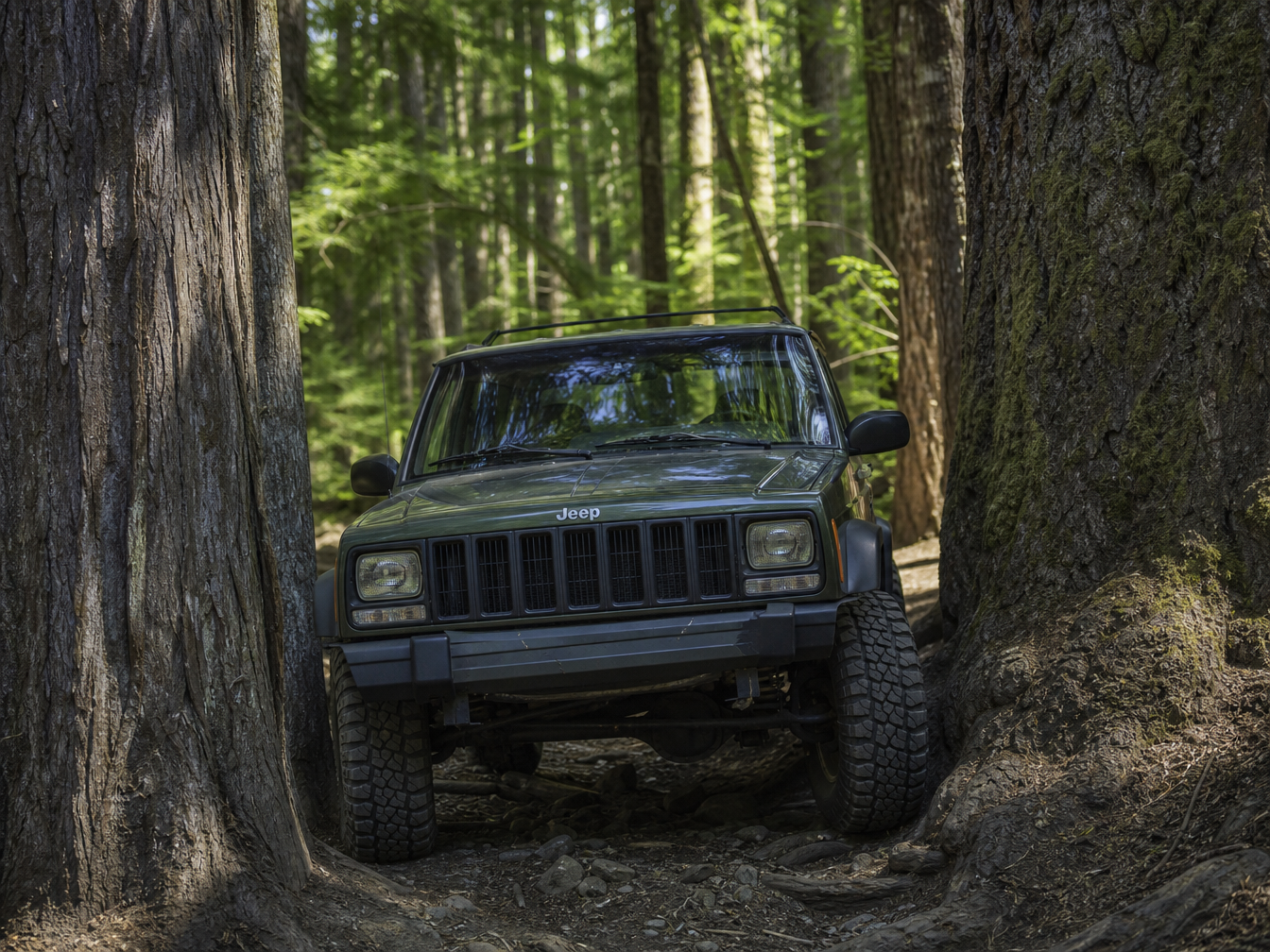
The XJ has a curb-to-curb turning diameter of approximately 34 feet. For reference, a Toyota Tacoma TRD is 42 feet. An XJ Cherokee parks like a compact car, navigates tight trailhead switchbacks that 4Runners and Tacomas have to three-point through, and fits in standard parking spaces without planning. Then it gets to the trailhead and, with a 3" lift and 33" tires, works through terrain that the truck platforms can't fit their wider body into.
On the highway, the XJ rides better than any solid-axle vehicle of its era has any right to. The unibody absorbs road irregularities in a way that body-on-frame trucks don't — the structure flexes slightly, which damps the impact before it reaches the cabin. XJ owners with 200,000-mile cars will tell you they've driven cross-country in them and arrived without back pain. People who own lifted body-on-frame trucks will tell you about every expansion joint on I-10 between Houston and El Paso. Both are driving solid axle vehicles. The XJ drives differently — and better — than the platform suggests it should.
Turning Radius
~34 ft curb-to-curb. Smaller than most compact cars. The XJ parks where trucks can't.
Curb Weight
~3,000 lbs stock. Nearly 800 lbs lighter than a 4Runner. Light matters on trail.
Unibody
Cars ride better than trucks. The XJ has car structure and truck axles. This should not be legal.
Parts Cost
XJ parts are dramatically cheaper than 4Runner parts. NAXJA has documented every failure mode since 1984.
The Jeep Comanche MJ — 1986 to 1992
The XJ Cherokee gets the recognition. The Comanche gets the respect. Produced from 1986 to 1992 alongside the XJ, the Comanche MJ is exactly what it looks like: an XJ Cherokee with a pickup truck bed grafted onto the same unibody platform. Same 2.5L four-cylinder and 4.0L I6 engine options. Same solid front and rear axles. Same compact wheelbase. Same bulletproof drivetrain. Different mission.
The Comanche was never produced in large numbers — Jeep built roughly 190,000 total over six years, compared to millions of XJ Cherokees — and most of them worked for a living. Logging operations. Farm service. Ranch work. The kind of daily duty that puts 50,000 miles on a truck in three years on roads that aren't roads. The ones that survived that work and are still in usable condition today are genuinely rare. A clean, rust-free Comanche in driving condition is prized in the Jeep community in a way that pristine examples of more common platforms simply are not.
In the Jeep community, the Comanche occupies a specific kind of reverence — not the nostalgia of the CJ, not the cult following of the XJ, but something more honest than either. The Comanche was a working truck. It went into woods that trucks twice its size wouldn't attempt, hauled loads that strained the rated payload because there was nobody to tell it not to, and came home. The 4.0L I6 that kept it going is the same engine that made the XJ legendary. The solid axles under it are the same platform the Jeep community has spent 40 years learning to build correctly. The Comanche is rare today not because it failed — but because the ones that were used hard enough to prove themselves were used hard enough to be used up.
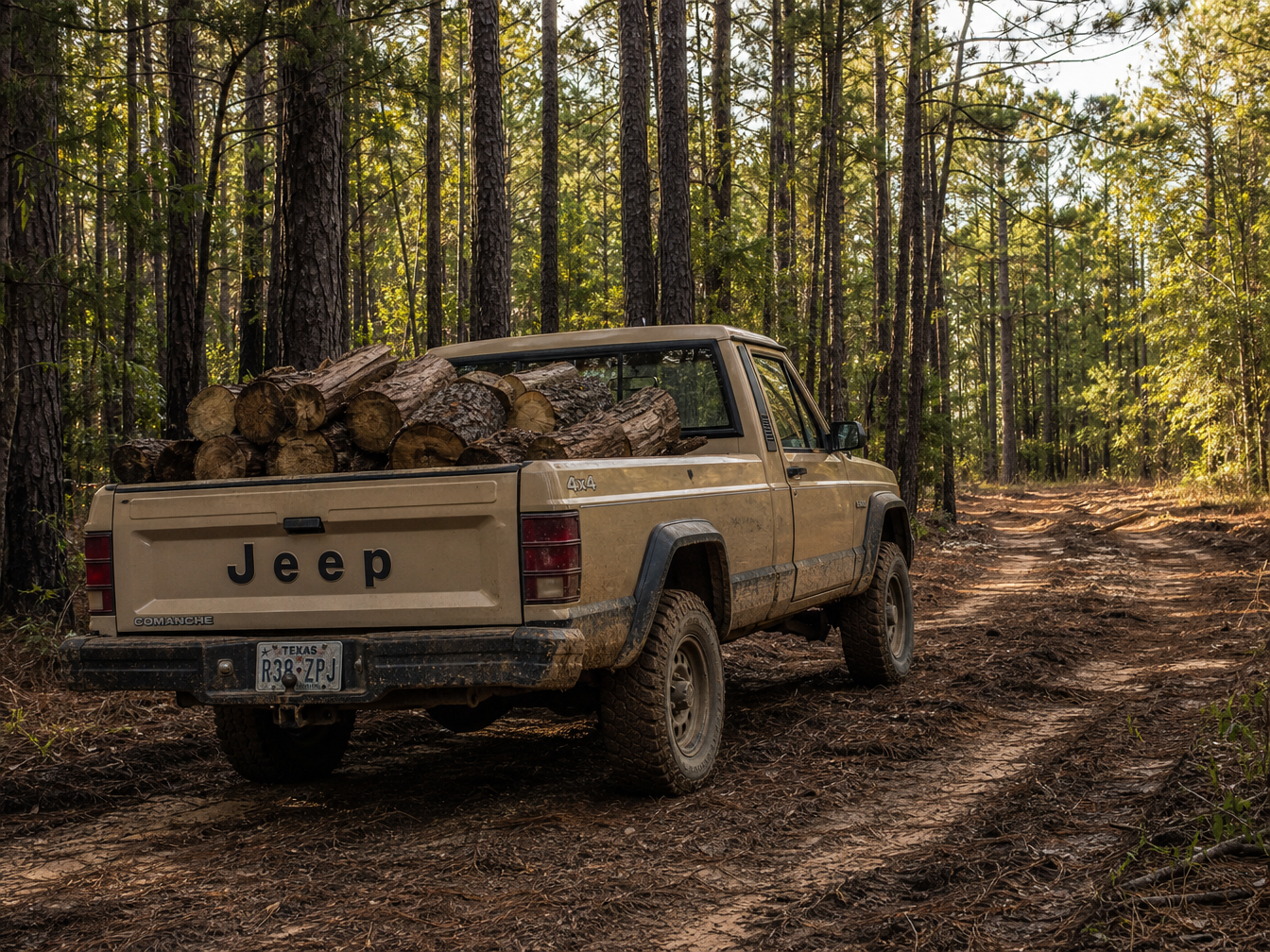
The Comanche was rated for 1,400 lbs of payload. Nobody who owned one treated that as a hard limit. The 4.0L didn't care. That is the Comanche story.
Doors Off. Top Down. Windshield Folded Flat.
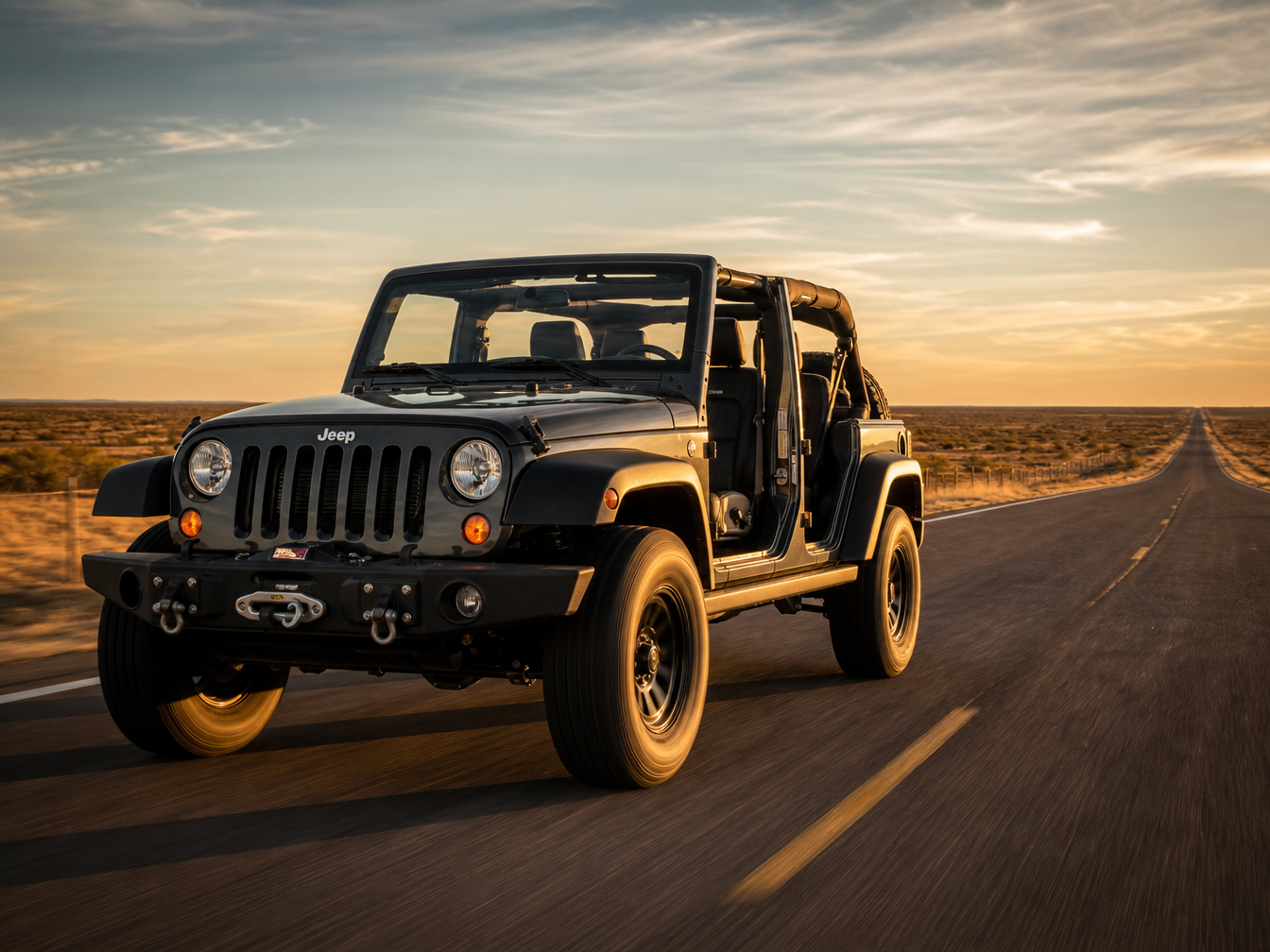
There is no other vehicle in production today that lets you remove the doors, fold the windshield flat, pull the top off, and drive 60 mph on the highway completely exposed to the atmosphere. Not the Ford Bronco — you can remove the doors, but you can't fold the windshield. Not the Jeep Gladiator by itself — the bed changes the equation. The Wrangler JK, TJ, YJ, and every CJ before them are the only vehicles available new or used where the driver can make the decision, on a Tuesday afternoon in March before the Houston heat arrives, to remove all four doors and the roof and make the commute genuinely different from every other commute they have ever made.
This matters to us because it matters to the people who buy Jeeps. They are not buying a vehicle to drive to work. They are buying a vehicle because it represents a version of driving that nothing else offers. That decision — to prioritize the experience over practicality, weather protection, road manners, and cargo capacity — is a decision that Jeep buyers make consciously. They know the limitations. They buy it anyway. That tells you something about who Jeep owners are as customers: they are committed to the platform and loyal to the community that surrounds it in a way that Tacoma owners and 4Runner owners simply are not at the same level.
Loyalty is the business case for building Jeeps exclusively. A Jeep owner who finds a shop they trust will bring every Jeep they ever own to that shop. They will refer every Jeep owner they know to that shop. They will drive 45 minutes past three closer options to go to the shop where the tech knows their platform. That customer relationship is different from the general truck and SUV market, and it is the relationship that Summit Jeep Works has been building for 12 years.
The Rivalries We Love — And the One Enemy We All Share
The Jeep community is not monolithic. It is fractured by platform, by headlight shape, by axle architecture, by how many inches of lift is "correct." These rivalries are not hostile — they are the texture of a community that has thought deeply about the same vehicle for 80 years and arrived at different but equally passionate conclusions. We love all of it.
YJ vs TJ
The YJ Wrangler arrived in 1987 and immediately divided the community by replacing the round headlights of the CJ with rectangular ones. Purists were angry. Practically, the YJ was a better daily driver — more comfortable, better windshield visibility, quieter on the highway. It also ran leaf springs front and rear, which the TJ corrected with coils in 1997. The TJ brought the round headlights back, went to coil suspension, and is widely considered the near-perfect version of the CJ spirit in a modern chassis. YJ owners will tell you their trucks are underrated. They are not wrong — a clean YJ with a 4.0L swap, a proper lift, and 33" tires is a serious trail machine. But the round headlights belong on a Wrangler. Everyone knows it. Even YJ owners know it.
XJ vs TJ
This is the foundational Jeep community debate. XJ people say: more practical, more comfortable, lighter, better turning radius, better ride, better cargo capacity, and just as capable on trail when built correctly. TJ people say: removable doors, open air, purpose-built off-road geometry from the factory, convertible. Both sides are right. The XJ and TJ are different answers to the question "what should a Jeep be?" — and the fact that the community is still having this argument 25 years after both platforms were in production simultaneously says everything about how good both answers are. We build both. We have opinions. Ask us in person.
JK vs JL Wrangler
When the JL arrived in 2018 with a turbocharged four-cylinder option, independent front suspension on the 4-door (briefly, before community pushback clarified that wasn't happening), and a full ADAS suite, the JK community had predictable concerns. Most of them were valid — the JL is more complex, requires ADAS recalibration on every lift, and introduced electronics that the aftermarket had to catch up to. What the JK community eventually had to admit: the JL is genuinely better in almost every measurable way. Stronger factory axles, better NVH, better highway manners, a more capable factory Rubicon. The JK's advantage is simplicity and a more mature aftermarket. Both are good Jeeps. Neither camp is wrong to prefer what they prefer.
Jeep vs Toyota
XJ vs TJ? Contentious. YJ headlights? Divisive. Jeep vs Toyota? The community is unified. The 4Runner community is legitimate — those are real off-road trucks driven by real off-road people with genuine knowledge and capability. But the 4Runner runs independent front suspension, which limits articulation and complicates repairs. The Tacoma is a great truck. It is not a Jeep. The FJ Cruiser was Toyota's attempt to compete directly with the Wrangler — and even Toyota fans will acknowledge that it never achieved what the Wrangler does. The Jeep wave exists for a reason. The Toyota community does not have a wave. There is a reason for that too. We respect Toyota trucks. We just don't build them.
The Jeep Wave
Every Jeep owner knows it. When two Wranglers pass on the road, drivers wave. Not a distracted half-wave — a deliberate acknowledgment between strangers that they made the same decision, chose the same platform, and belong to the same community. It is not formal. Nobody organized it. It emerged from a culture where the vehicle itself creates a bond between owners who have never met. The 4Runner community does not have a wave. The Tacoma community does not have a wave. Bronco owners wave now, because Bronco owners are largely ex-Jeep people who miss the culture enough to import it. The wave is not marketing. It is the most honest possible expression of what the Jeep community actually is: a self-selecting group of people who chose the harder, less refined, more committed option and feel recognized by everyone else who did the same.
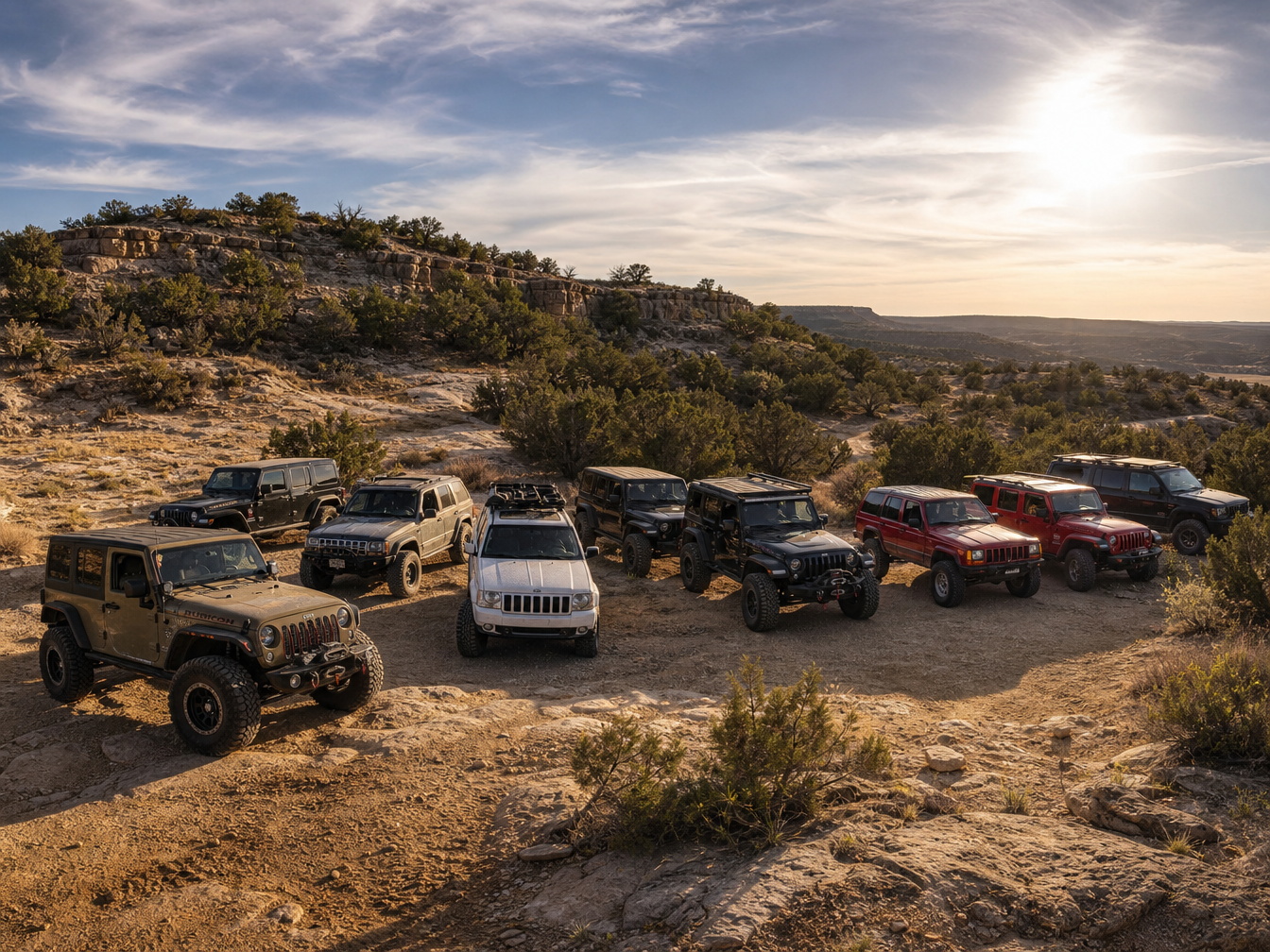
Jeep Lineage, 1941 to Today — The Weight of the Name
We are not going to write a full history of the Willys MB and the Battle of North Africa. You know the story. A small, light, go-anywhere military transport that could be operated and repaired by a 19-year-old with basic mechanical training, in a jungle or a desert, with available tools and a field manual. That was the design requirement. The vehicle that met it became the most recognized automotive shape in the world.
What matters to us about the lineage is not sentimentality — it is what the lineage says about the platform's fundamental design philosophy. The Willys MB was built to be repaired in the field by people who were not mechanics. Every part was standard, accessible, and available through supply chains designed to survive wartime disruption. That philosophy carried into every Jeep built afterward. The CJ. The YJ. The XJ. The TJ. The JK. The JL. In 84 years, Jeep has never fundamentally abandoned the idea that the vehicle should be understandable by the person driving it.
This is why the Jeep aftermarket is what it is. When a platform is designed to be worked on, the aftermarket builds around it. When a platform stays mechanically consistent for decades, the aftermarket deepens. The Dana axle architecture in a 2025 Gladiator JT Rubicon connects, in a direct and meaningful line, to the Dana components under a 1944 Willys MB. Different in every spec. Identical in philosophy.
The Aftermarket That Never Ends
Name any modification you want to make to a Wrangler, Cherokee, or Gladiator. There are multiple companies producing that part. There are forum threads from 2003 documenting every failure mode of that part. There are YouTube videos from five different builders who installed that part and explained exactly what they got wrong. There are NAXJA members who have been arguing about the correct version of that part for fifteen years. There is a group text somewhere in Houston right now that contains three people with direct personal experience with exactly the part you are considering.
This is the Jeep aftermarket. It is not an aftermarket — it is a living document of collective mechanical knowledge accumulated over 80 years by people who modify their vehicles, drive them hard, document the failures, and share the information freely. No other platform has this. The Toyota aftermarket is good. The Ford aftermarket is deep. The Jeep aftermarket is a civilization. And where the catalog ends, custom fabrication starts.
For a shop, this means something concrete: we know what breaks on every Jeep we build before we build it. We know the specific water pump impeller that fails on a 4.0L at 140,000 miles. We know the track bar drop bracket geometry issue on a JK at 3.5" lift that creates death wobble at 55 mph. We know the Dana 35 "Can Opener" problem and exactly when to address it and when the owner can wait. We know what to keep as spares for a JL doing a two-week Texas to Colorado trip. This knowledge is the product of the aftermarket — and the aftermarket exists because Jeep built a platform that the community decided was worth knowing this well.
Off-Road Capable Before You Touch a Single Bolt
A stock Jeep Wrangler Rubicon will drive through terrain that would strand a stock 4Runner, a stock Tacoma TRD Pro, and a stock Bronco Sport. This is not debatable — it is measurable. The Rubicon's factory 4:1 Rock-Trac transfer case, factory front and rear electronic lockers, front sway bar disconnect, and 33" Goodyear MT tires on a vehicle with factory ground clearance of 10.8 inches represent a baseline that no other mass-market vehicle matches. A stock Wrangler Rubicon will climb granite at Katemcy Rocks that requires genuine skill and equipment from every other platform. Before a single modification. That is the starting line — and then we go from there.
Approach Angle
44 degrees on the JL Rubicon stock. The closest truck competitor is more than 10 degrees behind. You know what a degree of approach angle costs in a modified build.
Factory Lockers
Rubicon trim: factory front and rear Tru-Lok electric lockers. The competition charges extra for aftermarket lockers. Jeep includes them in the base Rubicon package.
4:1 Low Range
Rock-Trac NP241OR at 4:1 low range on every Wrangler and Gladiator Rubicon. Most trucks offer 2.5:1 to 2.72:1. The math is not subtle.
Why We Only Build Jeeps
Every argument on this page is a practical one. The solid axles. The 4.0L. The predictable failure modes. The aftermarket depth. The community loyalty. The platform consistency from 1941 to 2025. These are the reasons a shop decides to specialize rather than generalize.
Generalist shops take every truck that walks in the door. They know a little about a lot. They install lift kits on platforms they build twice a year and quote from memory of a different truck they built six months ago. When the JL Wrangler arrived with ADAS systems that require recalibration after every geometry change, the generalist shops either didn't know or didn't mention it. They installed the lift, aligned the vehicle, and sent it home with safety systems operating on incorrect calibration. We knew about ADAS recalibration before we installed a single JL lift — because we had spent six months reading the JL documentation, the NAXJA forum threads, and the TeraFlex installation notes before the platform was common enough for the problem to show up at our door.
That is what specialization produces. Not just knowledge — anticipation. We know what the JT Gladiator's payload issues look like before the customer who is planning an overland build realizes they're buying the wrong trim for the gear list they're planning. We know the Dana 35 "Can Opener" failure mode before the XJ owner at Stage 1 knows they have a Dana 35. We know the death wobble trigger on a JK lift before the customer has experienced it. The depth of knowledge that comes from building one platform exclusively is the most valuable thing we have to offer — and it is directly responsible for every 4.9-star review in our 127-review history.
We chose Jeeps because Jeeps reward expertise. The platform is deep enough that you can spend 12 years learning it and still have more to learn. The community is large enough that a Jeep-specialist shop in Houston can fill a six-bay shop entirely with Wranglers, Cherokees, and Gladiators and never have a slow month. The aftermarket is rich enough that we can source a solution to any problem a customer brings in — because the solution already exists, already has forum documentation, and already has a failure rate that we can quote from memory.
And the vehicle itself — the experience of driving one with the doors off and the top down through a Texas March morning before the heat arrives — is unlike anything else on the road. That experience is why people buy Jeeps. We built a shop around being worthy of that choice.
Building Jeeps for Owners Across Greater Houston
Summit Jeep Works serves Wrangler, Cherokee, and Gladiator owners from across the Houston metro. Come in — bring the Jeep.
Houston, TX 77057
Sat 9am–4pm