Rock Crawler Builds.
Houston, TX.
This is not a trail rig page. If you are still running body panels, a windshield, and a highway alignment — you are not building a rock crawler yet. This page is for the build that comes after that one.
Summit Jeep Works builds purpose-built and trail-to-crawler transition Jeeps in Houston — double-triangulated four-link systems, full Atlas transfer case installs, Dana 44 and one-ton axle work, XJ unibody reinforcement, cage tie-ins, and full hydraulic steering conversion for dedicated crawlers. If you know what those words mean, keep reading.
Where the Trail Rig Ends and the Rock Crawler Begins
A Stage 2 trail rig is a genuine achievement. 35s or 37s on a quality suspension system, lockers, armor, and a proper alignment — that Jeep handles 95% of what the Houston area offers and most of what East Texas and the Hill Country will throw at it. But there is a line between a capable trail rig and a purpose-built rock crawler, and the engineering on both sides of that line is genuinely different. Not just "more of the same." Different.
A dedicated rock crawler is a single-purpose machine. Non-essential body panels come off. The windshield may come off. Every pound of unnecessary weight that raises the center of gravity is a pound working against you on a near-vertical granite ledge. Front tires run sticky competition rubber at 8 to 10 psi — and on serious builds, up to 175 pounds of water ballast goes inside the front tires to pin the front end down and prevent backward rolls on vertical climbs.
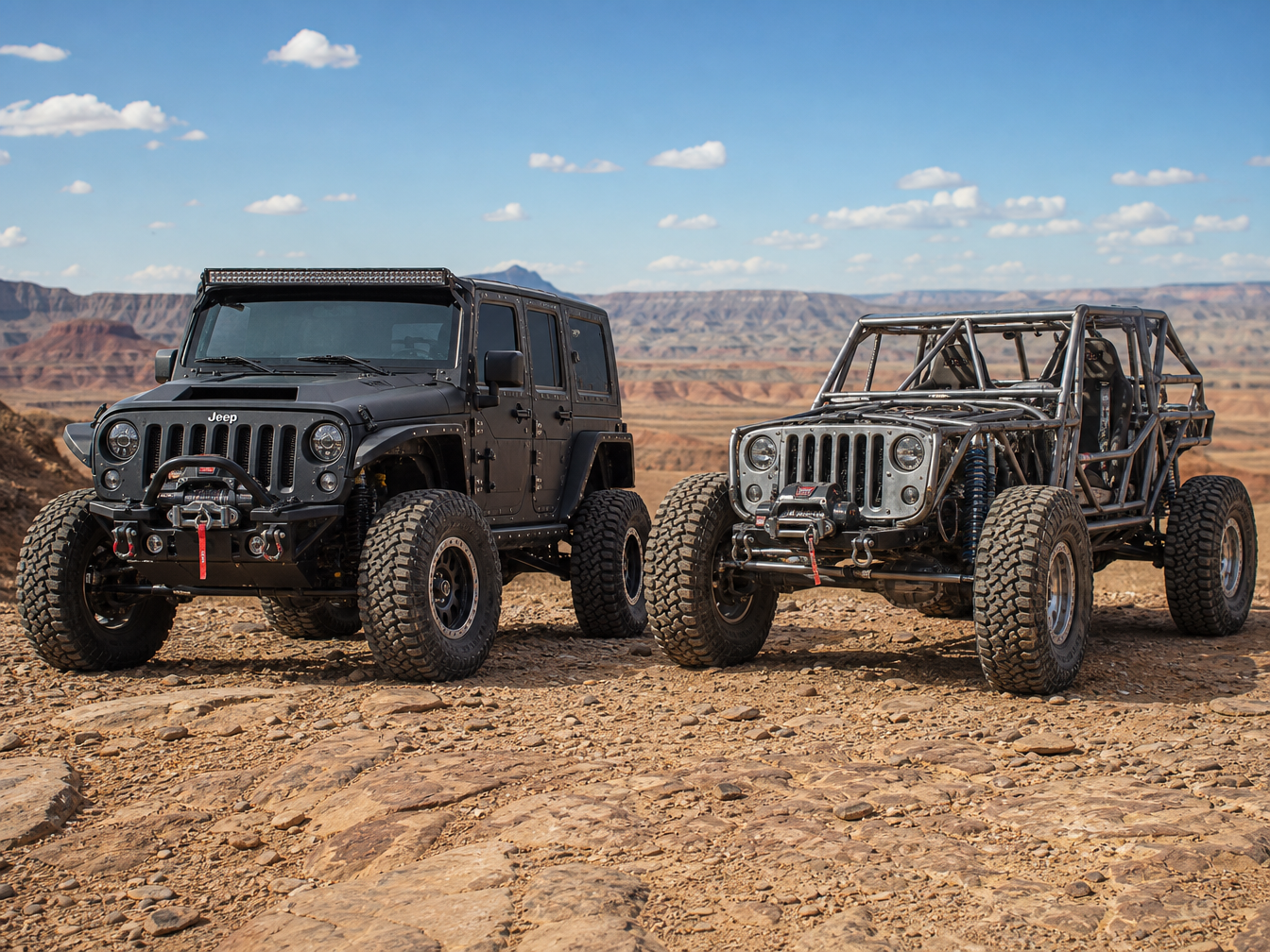
The trail rig and the rock crawler share the same Jeep platform and some of the same parts. That is approximately where the similarity ends. Crawl ratios exceeding 100:1 — sometimes 200:1 — against the trail rig's typical 31:1. Custom-fabricated double-triangulated four-link suspension versus bolt-on long arm. Full hydraulic steering versus hydro-assist. Frame back-halving on JK builds. Full cage work tied to the chassis. These are not upgrades to a trail rig. They are a different class of vehicle built on a familiar chassis.
| Feature | Stage 2 Trail Rig | Dedicated Rock Crawler |
|---|---|---|
| Tire Pressure | 12–15 PSI (trail) | 8–10 PSI, sticky compound |
| Crawl Ratio | ~31:1 | 100:1 to 200:1+ |
| Suspension | Long-arm lift kit | Custom double-triangulated 4-link |
| Steering | Hydro-assist | Full hydraulic (trailer queen) |
| Body | Full panels, windshield | Stripped, minimum structure |
| Wheelbase | Factory | Stretched to 100"–112"+ |
| Use | Trail + highway | Trail only — trailered |
| Build Cost | $5,000–$14,000 | $15,000–$60,000+ |
What a Rock Crawler Is Actually Made Of
Five systems define the difference between a trail rig and a purpose-built crawler. Here's what each one is, why it exists, and what we build toward at each level.
Double-Triangulated Four-Link
The bolt-on long-arm suspension kit on a Stage 2 trail rig is geometrically limited — and those limits show up on vertical obstacles. A dedicated rock crawler runs a custom-fabricated double-triangulated four-link system because the geometry does things a long-arm kit cannot.
In a double-triangulated setup, both the upper and lower control arms are angled inward to form a dual "X" pattern when viewed from above. This geometry simultaneously handles lateral and longitudinal axle location — eliminating the need for a rear Panhard bar entirely. No Panhard bar means no rear steer as the suspension cycles. The axle travels straight up and down, which gives the driver total predictability on steep off-camber lines where rear steer will put you off the intended path fast.
Beyond zero rear steer, the four-link eliminates axle wrap — the rotational torque twist under hard acceleration that causes wheel hop and breaks components. And it enables wheelbase stretching, moving the rear axle rearward to the "magic" range of 100 to 112+ inches that prevents backward rollovers on near-vertical climbs. Coilovers on a crawler are tuned for this work: 12 to 14 inches of travel, with very little up-travel (often under 5 inches) so the vehicle sits as low to the ground as possible. The goal is minimum center of gravity, not maximum lift. On the RTI ramp, that geometry is measurable — the ramp proves what a 4-link actually does.
One-Ton Axles, 300M Shafts, Crawl Ratios That Mean Something
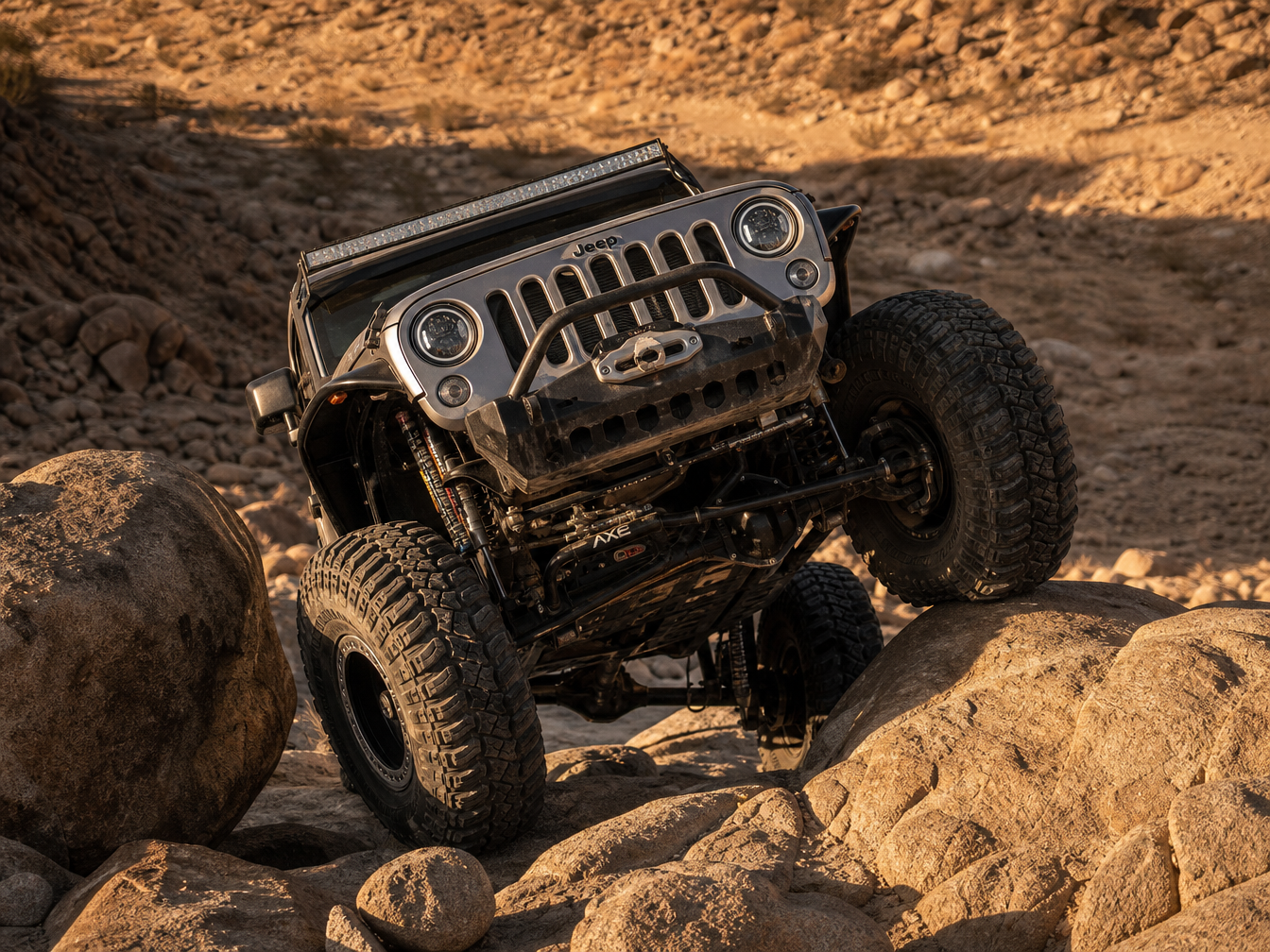
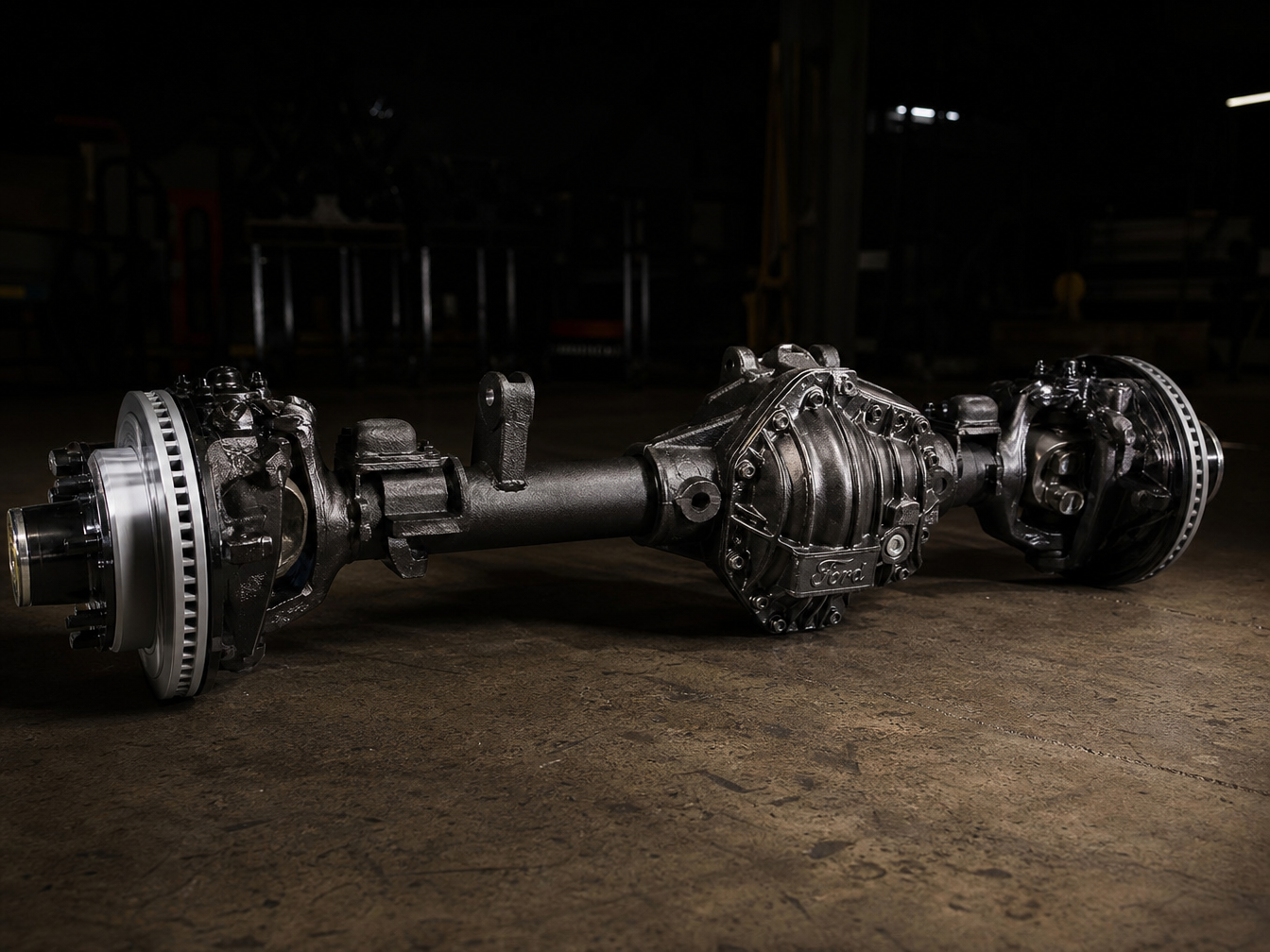
A rock crawler running 40-inch tires on high-traction granite does not run a Dana 44. The industry standard for serious crawlers is the high-pinion Ford Super Duty Dana 60 up front — chosen for its massive center section, heavy-duty knuckles, and ground clearance from the high-pinion geometry — and a shaved GM 14-bolt or Dana 80 in the rear. The 14-bolt gets its lower housing lip removed to reclaim clearance, and dually hubs are swapped to narrow it for trail use.
Gear ratios run low: 4.10:1, 4.56:1, and up to 5.38:1 on builds running 40- to 54-inch tires. Axle shafts throughout are 300M chromoly — ultra-high-strength material that handles shock loads of competition tires where standard steel snaps. Front axles typically run selectable lockers (ARB Air Locker). Rear axles often run a spool or selectable locker to enable front-dig maneuvers with the Atlas twin-stick.
Front axle overdrive is a crawler-specific setup: the front axle is geared 20 to 30 percent faster than the rear. On pavement, this causes severe tire scrub and is undrivable. On a vertical rock face, it actively pulls the front wheels over the ledge while the rear tires push. Without it, the rear tires push the rig off its intended line.
Portal axles (74Weld Gen2) bolt to factory housings and provide approximately 4 inches of clearance gain directly under the differential — clearance no suspension lift can replicate. The portal's 22% hub reduction means a Dana 44 with 4.10 gears becomes a 5.00:1 final drive at the wheel. For extreme builds targeting 40-inch tires, portals cost approximately $19,150 installed — against $33,820 for a traditional Dana 60 / 14-bolt swap. The $14,670 cost difference is real. The portal's ~60 mph highway speed cap is also real. This conversation always starts with how the Jeep gets to the trail.
The Atlas. And Why Everything Else Is a Compromise.
The Advance Adapters Atlas transfer case is the standard for serious rock crawler builds. Factory and upgraded factory transfer cases are chain-driven. The Atlas is gear-driven — fully helical-cut hardened steel gears in a one-piece 356-T6 heat-treated aluminum housing. No chain to stretch. No chain to break. Built to order, meaning the low-range gear set is specified for your axle ratios and tire size — ratios from 1.5:1 for desert racing to 5.0:1 for maximum rock crawling reduction.
On a Jeep with 4.88:1 axle gears, a transmission first gear of 4.0:1, and an Atlas at 5.0:1 low: 97.6:1 crawl ratio before portal hub reduction. Stack a RubiCrawler planetary reduction unit (2.72:1) inline and that ratio exceeds 265:1. At that ratio the Jeep moves at walking pace on idle with no throttle input. That is the control level competition rock crawling demands.
The Atlas also includes twin-stick shifting — independent front and rear output shaft control. This enables Front-Wheel Drive Low (FWD-Low): power only to the front axle, rear axle disengaged, rear brakes locked via a cutting brake. This is the front dig — the maneuver that lets a crawler pivot its entire mass around the rear axle in a tight turn where standard four-wheel-drive geometry would have the rig backing up. The Atlas Pro Series upgrades the unit for unlimited-class work: 1.5-inch idler shaft, 300M output shafts, and super-finished gears. One additional detail: the Atlas is 2.5 inches shorter than a factory NP231 — critical for short-wheelbase TJ and YJ builds where driveline angles matter.
Atlas 2-speed versus 4-speed: The 2-speed covers the majority of purpose-built crawler work. The 4-speed adds two intermediate gear positions for more precise control in competition environments. Trail Series for serious trail crawlers; Pro Series (Race Case) for unlimited class and competition environments where additional strength margin matters.
Frame Tie-Ins, DOM Tube, and the Difference Between a Roll Bar and a Roll Cage
A bolt-in sport cage bolts to the vehicle's floor pan. Under a high-impact multi-axis rollover — the kind that happens on boulder fields, not highway medians — a bolt-in cage punches through the floor and collapses. On a technical rock crawler, this is the expected failure mode under repeated hard use, not a worst-case scenario.
A purpose-built roll cage for serious crawling is fabricated from 1.75- to 2-inch thick-wall DOM (Drawn Over Mandrel) steel tube, fully welded, and tied to the vehicle's frame rails using frame tie-in kits. The frame tie-in is the piece most often omitted. A weld-in cage attached only to the body or floor pan transfers the load of a rollover to sheet metal — which is inadequate. A frame-mounted cage routes that load directly into the chassis. Frame tie-in kits sandwich the floor with heavy steel plates, run structural tube from those plates to the frame rails, and use high-density polyurethane bushings to isolate the cabin from trail vibration without reducing rollover protection.
On JK builds heading toward competition configuration, the back-half frame modification precedes cage work. Factory rear frame rails are cut and replaced with 3/16-inch CAD-designed steel sections. Rails move inward 5 inches per side above the axle centerline to create clearance for outboard coilovers. The rear frame arch raises 1-1/8 inches for more axle upward travel. The rear frame shortens 2.5 inches to improve departure angle. Factory fuel tank removed, custom aluminum fuel cell installed. This is the structural foundation the cage and four-link mount to.
Hydro-Assist for the Trail. Full Hydraulic for the Trailer Queen.
Hydro-assist steering retains the mechanical drag link. If a hydraulic line fails, if the engine dies, if a fitting lets go — the driver still has manual steering control. For a Wrangler or XJ that drives to the trail, hydro-assist is the correct steering upgrade. It adds meaningful turning force for big tires without removing the safety redundancy that highway driving demands.
Full hydraulic steering removes the mechanical linkage entirely. An orbital valve sends high-pressure fluid to a double-ended ram mounted directly to the front axle housing. On dry granite with 40-inch sticky tires fully bound up against rock, this provides effortless turning force that no mechanical or hydro-assist setup can match. The tradeoff is absolute: zero road feel, hypersensitive response, and immediate total steering loss if hydraulic pressure is lost for any reason. Full hydro vehicles are twitchy and dangerous above 25 to 50 mph.
Full hydraulic steering is the correct call when: the build runs 40-inch or larger sticky competition tires, the vehicle is a dedicated trailer queen that never sees highway speed, and the suspension architecture is a custom multi-link front where packaging a drag link creates geometric impossibility or severe bump steer. If the Jeep drives 60 miles on 290 to reach Katemcy Rocks, full hydro is not the right call. Hydro-assist is.
JK, JL, and XJ — What Each Platform Needs
Three platforms dominate the Texas rock crawling scene. Here is what each one brings and what each one requires before serious crawler work can begin.
The most fully developed rock crawler platform in production history. Twelve years, millions of units, and an aftermarket so deep that every modification path has been done, documented, and refined multiple times. Back-half frame kits for the JK are production items. Double-triangulated 4-link systems are production items. The JK Rubicon's factory Dana 44 front and rear with Rock-Trac is a legitimate Stage 2 starting point.
For crawler work: back-half frame modification on JKU Unlimited builds, Atlas transfer case replacing the NP231 or Rock-Trac, custom 4-link front and rear, high-steer knuckles, one-ton axle work or portal conversion for 40-inch builds, full cage with frame tie-in. Body stiffener kit is standard before any serious structural work begins.
The rock crawler the community built from a unibody SUV. Light weight, tight wheelbase, and exceptional factory suspension geometry create a crawler that fits lines trucks can't touch. NAXJA has spent 40 years developing the XJ crawler build into a documented, repeatable process.
The starting requirement is unibody reinforcement — full-length stiffener packages (CNC-cut 10-gauge or 3/16-inch steel, rosette-welded throughout) must be installed before any serious suspension or cage work. Inner steering box reinforcement is non-negotiable on any XJ running hydro-assist or full hydro. Dana 44 rear swap from the Dana 35 is Stage 2 standard. SYE and CV driveshaft required at lift above 3 inches. A properly built XJ on competition granite is one of the most capable compact crawlers the sport has ever produced.
The JL Rubicon is the strongest factory crawler foundation Jeep has ever sold. AdvanTEK Dana 44 axles front and rear, Rock-Trac NP241OR, and factory electronic lockers. For Stage 1 and Stage 2 builds, the JL Rubicon requires less corrective work than a non-Rubicon JK at the same capability tier.
For crawler-level builds, the JL introduces complexity: ADAS recalibration is required at every geometry change — no exceptions. At Stage 3, the ADAS conversation becomes a decision: full recalibration at extreme new geometry with specialized equipment, or ADAS delete for a dedicated trail-only vehicle. The Atlas transfer case swap on a JL is more involved than on a JK due to drivetrain differences. This is the conversation we have at the beginning of a Stage 3 JL quote — not at the end.
The Terrain, the Venues, and Why Central Texas Is the Southern Benchmark
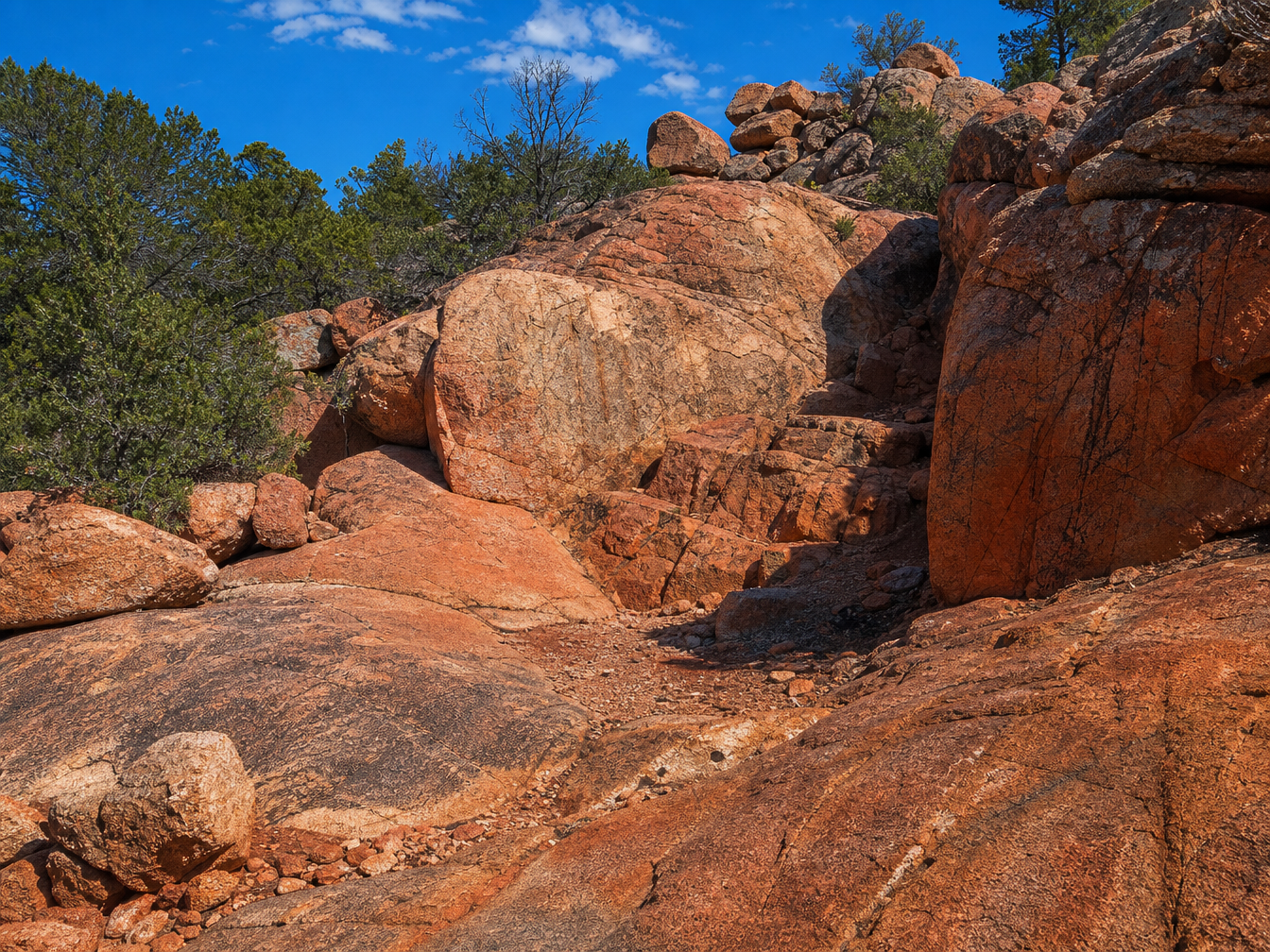
Central Texas — specifically Mason County's red granite — produces some of the most technically demanding and traction-rich rock crawling terrain in the southern United States. The geology matters. Red granite is highly abrasive and provides exceptional, predictable traction on near-vertical faces — the terrain where sticky competition tires and single-digit tire pressures become structurally necessary, not optional.
Limestone terrain in the Hill Country behaves entirely differently: it crushes into fine white dust that reduces traction and demands different tire strategy. On limestone, drivers need aggressive mud-terrain tread and higher wheel speeds to clean dust out of the tread during steep climbs. A tire compound and pressure strategy optimized for granite will fail on limestone. Houston-based builders running both terrains need to understand why and set up accordingly.
Community: NAXJA Southern chapters are the organized backbone of XJ crawler culture in Texas — trail runs and structural fabrication workshops. Lone Star Land Cruisers coordinates the most significant annual events and maintains active regional chapters. The IH8MUD forums and NAXJA forums are where this community documents builds, shares failure analysis, and sources parts. Builders who compete at the Mason County level know each other. If you're building a serious Jeep crawler for Central Texas granite, this community is your peer group and your reference network.
Three Tiers. What Each One Costs and What Each One Does.
Real numbers from recent builds — not estimates. Ranges exist because base vehicle condition, platform, and parts tier all affect the final number. These are your reference point for a realistic conversation — not a quote.
Tire size: 37 inches. Terrain target: Level 7–8 trails, Barnwell Mountain, Rocky Hill Ranch, moderate Hill Country. Not appropriate for competition granite or extreme vertical obstacles.
Traditional path (~$15,075): High-quality long-arm or short-arm suspension, regeared axles (4.56 or 4.88), chromoly shaft upgrades, heavy-duty driveshafts, armor package.
Portal path (~$17,850): Portal installation on factory axle housing. Same terrain capability as traditional Tier 1 but with 4 inches of immediate clearance gain and 22% less upstream drivetrain stress.
Tire size: 40 inches and larger. Terrain target: Vertical ledges, extreme granite obstacles, Level 9+. Katemcy Rocks, Wolf Caves, competition environments.
Traditional path (~$33,820–$45,000+): One-ton axle swaps (Dana 60 front, GM 14-bolt or Dana 80 rear), regeared to 4.88 or 5.38, custom 4-link or long-arm, full armor, extensive custom fabrication. Full custom linked SAS by a serious shop: $40,000–$60,000 on the high end.
Portal path (~$19,150): $14,670 cheaper than the traditional swap at this tier. Portals bolt to factory housings — no custom axle fitting labor. Constraint: ~60 mph highway speed cap. If the Jeep gets trailered, portals are the economically superior choice.
Excludes base vehicle cost. These are trailer queens. They do not drive to the trail. They are built to win in competition environments where the rules allow any modification.
Custom engine swaps (LS V8 most common), full tube chassis or backhalved factory frame, Atlas 4-speed transfer case, full hydraulic steering, custom DOM roll cage frame-tied to chassis, double-triangulated 4-link front and rear with bypass shocks and coilovers, 40- to 54-inch competition rubber.
Summit Jeep Works builds Tier 1 and Tier 2 comprehensively. Tier 3 custom tube chassis and full buggy work is quoted on a project basis. Come in and describe the build. And before you commission one, you can drive our Stage 3 shop crawler yourself.
Rock Crawler Questions. Straight Answers.
Ten technical questions. If these are the questions you're asking, you're the customer we build for.
Houston, TX 77057
Sat 9am–4pm