JK & JL Wrangler Builds in Houston
— Built the Way the Platform Demands
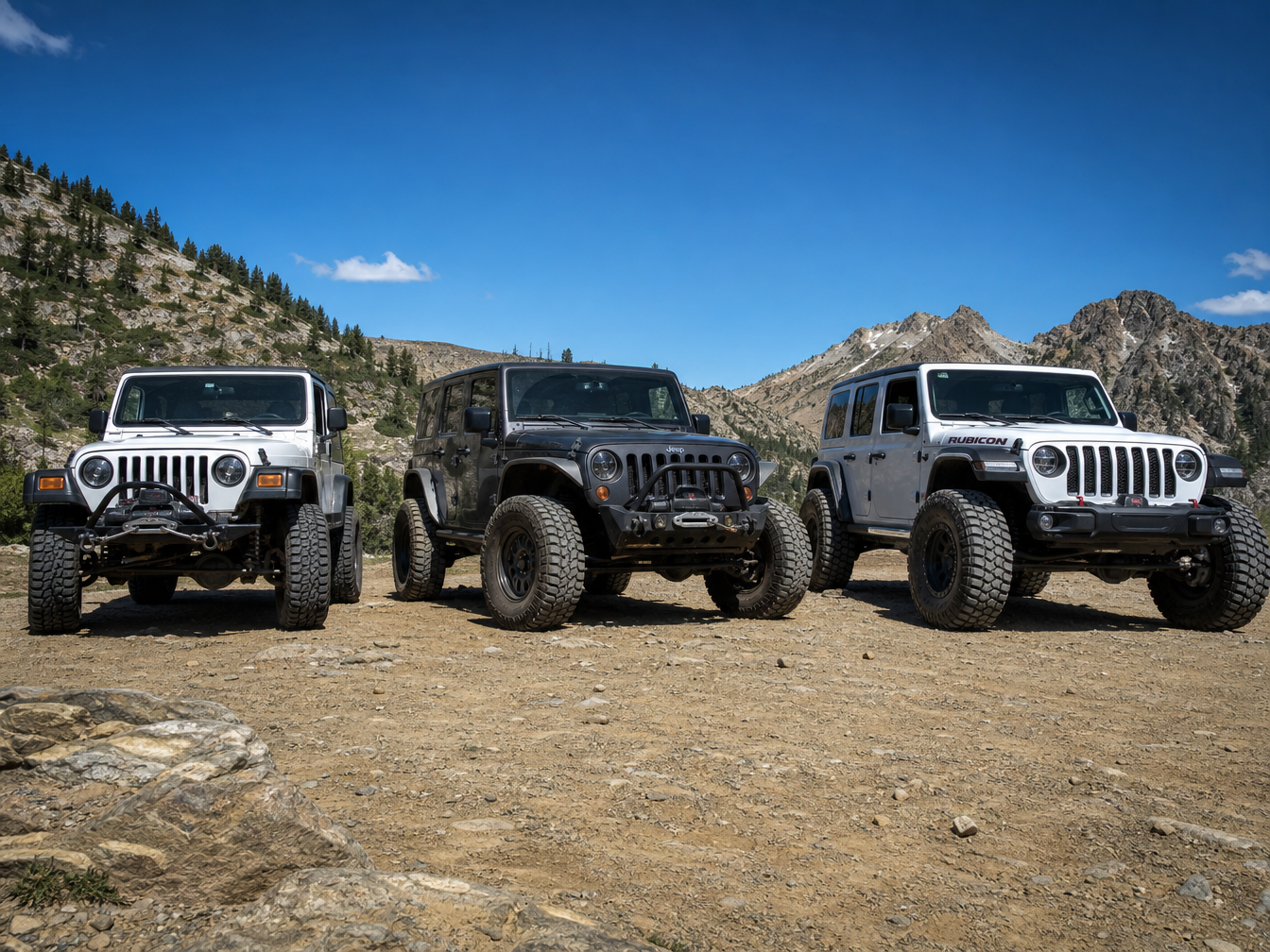
The JK was the Wrangler the community learned to build correctly. The JL is the Wrangler Jeep finally got right from the factory. We build both — and we know which one needs what.
Summit Jeep Works builds JK and JL Wranglers in Houston — from Stage 1 entry lifts to Stage 3 long-arm competition builds. We know the 3.8L oil consumption problem, the JK death wobble sequence, the JL ADAS calibration requirement, and what separates a Wrangler built to perform from one built to fail six months from now.
No appointment needed · Bring the Wrangler · Walk away with a real build plan
JK vs JL: Two Generations, Different Rules for Each
We address the JK and JL on the same page because, at the foundation, they share enough DNA to discuss together — the solid axle architecture, the Wrangler brand identity, the overlapping community, and most of the build philosophy. But they are not the same Jeep, and anyone who treats them the same at the shop level is doing one of them wrong.
The JK ran from 2007 to 2018 and built the most mature aftermarket of any Wrangler ever produced. Eleven years and hundreds of thousands of units gave the off-road community time to find every failure mode, develop every fix, and establish every preferred build path. The JK is the platform most shops have the deepest experience with — and the platform where the most bad installs have happened, because depth of experience doesn't guarantee quality of execution.
The JK's failure modes are well-documented. The solutions are well-established. The builds are well-understood. The question isn't whether we know what to do — it's whether we execute it correctly.
The JL launched in 2018 and changed the rules. Better factory hardware, stronger axles on the Rubicon, more engine options, and an ADAS (Advanced Driver Assistance Systems) suite that requires calibration every time the suspension geometry changes. That last point is where shops separate themselves. The shops that know the JL include ADAS recalibration in every lift quote. The shops that don't know the JL create safety systems that no longer function correctly.
Summit Jeep Works builds both. Here's what you need to know about each.
JK and JL Wrangler Specs — The Numbers Behind Both Platforms
| Engine | Years | Notes |
|---|---|---|
| 3.8L V6 | 2007–2011 | Known weak point. Oil consumption, exhaust manifold stud failures, HG vulnerability. Avoid for serious builds. |
| 3.6L Pentastar V6 | 2012–2018 | The engine the JK should have launched with. More power, better economy, reliable. Our recommendation for any JK build. |
| Position | Axle | Fitment | Notes |
|---|---|---|---|
| Front | Dana 30 | Sport / Sahara | Serviceable to 33–35" with correct shafts |
| Front | Dana 44 | Rubicon | Factory electronic locker — the primary reason the Rubicon premium exists |
| Rear | Dana 35 | Sport / Sahara | Stage 2 upgrade target for serious trail use |
| Rear | Dana 44 | Rubicon | Factory electronic locker front and rear — genuine capability from the factory |
| T-case | NP231 Command-Trac | Sport | Two-speed part-time 4WD |
| T-case | NP241OR Rock-Trac | Rubicon | 4:1 low range — meaningfully different on technical terrain |
| Engine | Notes |
|---|---|
| 3.6L Pentastar V6 | Most common — well-proven from JK era. The safe and predictable choice for most builds. |
| 2.0L Turbo I4 (eTorque) | Strong low-RPM torque, different character than V6 — some builders prefer it. |
| 3.0L EcoDiesel V6 | Best for overlanding, extended range, and towing. Preferred for heavy load builds. |
| 2.0L + Electric (4xe PHEV) | Trail capable — unique build and charging considerations require a separate conversation. |
| 6.4L Hemi V8 (Rubicon 392) | Factory performance trail variant — for a specific buyer profile with a different build path. |
| Position | Axle | Fitment | Notes |
|---|---|---|---|
| Front | Dana 30 | Sport | Standard front on non-Rubicon trims |
| Front | Dana 44 AdvanTEK | Rubicon | Stronger gear geometry than JK Dana 44 — purpose-built for the JL |
| Rear | Dana 44 AdvanTEK | Rubicon | Both axles upgraded on Rubicon — the most capable factory Wrangler ever sold |
| T-case | NP241OR Rock-Trac | Rubicon | Same 4:1 low range as JK Rubicon |
Common JK & JL Wrangler Problems — What Causes Them and What We Do
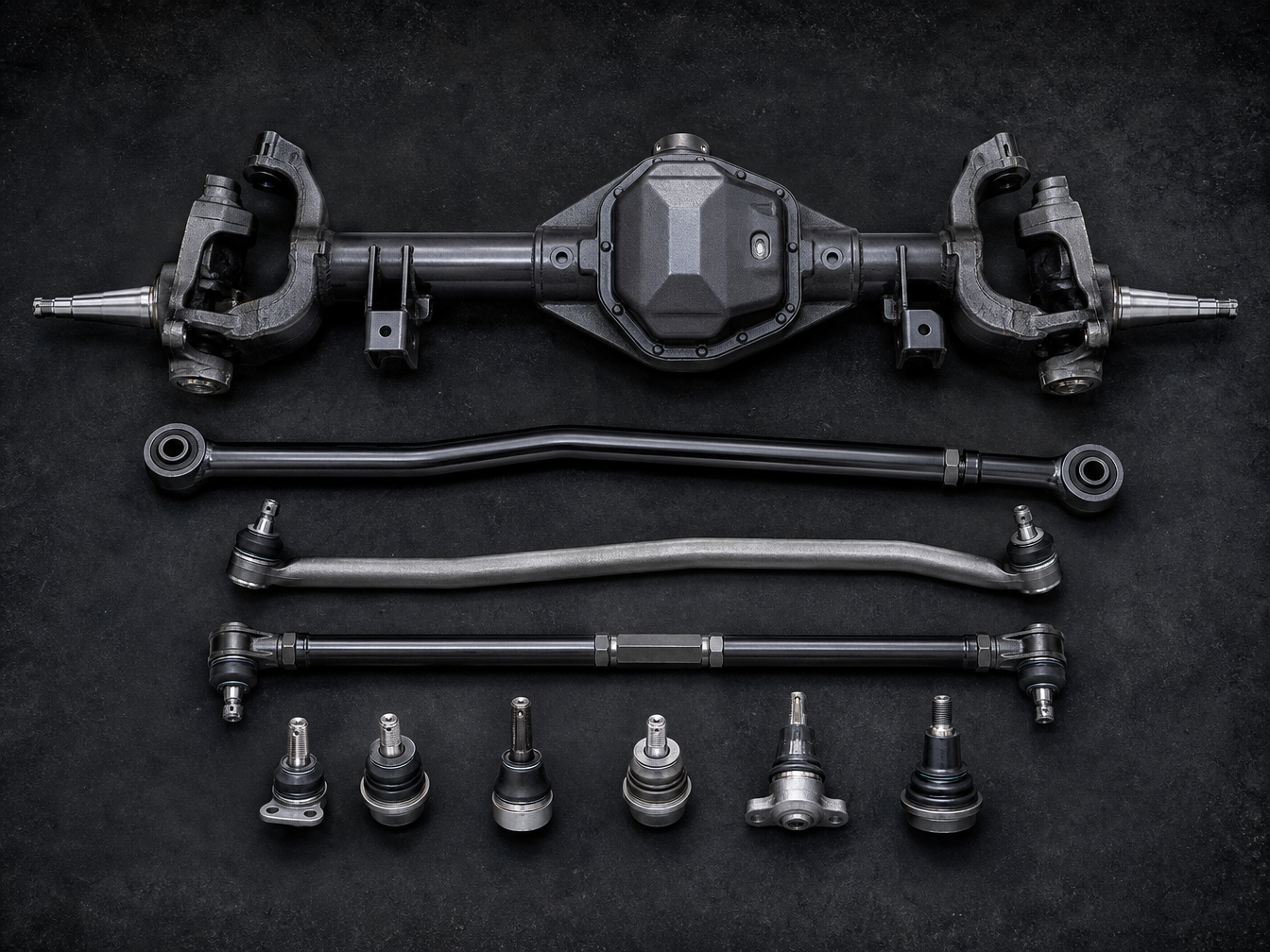
A cascade of worn front-end components — track bar end, ball joints, tie rod ends, steering stabilizer — that create a resonance at highway speed building into a violent steering oscillation. Every 4"+ JK lift changes geometry enough to accelerate this cascade if not proactively addressed.
What we do: Front-end refresh is standard at every JK lift installation above 2". Track bar correction bracket mandatory at 4"+. We don't install lifts on JKs without addressing the front end — the safety liability doesn't allow it.
JK wobbling above 55 mph? Book a death wobble diagnosis →Valve stem seal failure causes progressive oil burning. Exhaust manifold studs crack from heat cycling — so commonly it's considered a scheduled maintenance item on early JK builds.
What we do: Full service history review before Stage 2 investment on any 2007–2011 JK. Exhaust manifold studs replaced as a matter of course on early models coming in for a build. This is a documented conversation before we accept the deposit.
The JK shipped with soft, vague factory steering that wanders at highway speed and resists precise inputs. Every shop that builds JKs has this conversation with new customers. It's factory design — but it's unacceptable on a lifted trail rig.
What we do: Aftermarket heavy-duty steering (JK-specific drag link and tie rod) is standard at Stage 1 for any trail-focused build. A lifted JK does not leave our shop with factory steering.
The JK Unlimited 4-door body experiences measurable flex under trail stress without reinforcement — visible door gap changes, occasional creak, and structural fatigue over time.
What we do: JKU stiffener kit included at Stage 1 on every Unlimited build. A modest cost that protects the structural investment of everything that comes after it.
The JL ships with blind spot monitoring, automatic emergency braking, forward collision warning, and lane keep assist — all calibrated to factory ride height. Every lift changes the camera and radar angles these systems depend on. A JL lifted without ADAS recalibration has safety systems that no longer function correctly. This is both a safety issue and a shop liability issue.
What we do: ADAS recalibration is included in every JL lift quote, without exception. This is the single biggest differentiator between shops that know the JL and shops that don't.
JL lifted without ADAS recalibration? Come in for a safety check →The JL's Dana 44 AdvanTEK axles are stronger than the JK's axle stack, but failure modes are different from the familiar JK Dana 44. Shops used to JK axles won't necessarily diagnose an AdvanTEK failure the same way.
What we do: We know the AdvanTEK's service intervals, failure signatures, and what loads it handles correctly on 37"+ builds. We flag it when a JL is being pushed past the AdvanTEK's intended range.
The 4xe adds a battery pack that changes weight distribution, heat management, and recovery considerations. A 4xe with a depleted battery trail-climbs on engine only. Recovery and charging access on remote trails needs a documented plan.
What we do: Discuss 4xe-specific build considerations before the first modification. Not all parts designed for standard JL fit the 4xe correctly — the conversation matters before the order is placed.
Why the Wrangler Is the Platform Every Other Jeep Gets Compared To.
The Wrangler is the only vehicle in production that has maintained continuous off-road DNA from its WWII military ancestor to the current model year. Every other 4x4 on the market is optimized for some compromise with on-road use. The Wrangler is optimized for the trail first — and the JK and JL are the two most capable expressions of that commitment to exist in mass production.
The JK community is the deepest in Wrangler history. Twelve years of production, millions of units, and a fully matured aftermarket means there is no problem, no build goal, and no configuration the JK community hasn't solved. The documentation is exhaustive. Parts availability is excellent. Community knowledge is encyclopedic. Building a JK in 2026 means standing on the shoulders of fifteen years of collective experience.
The JL community is newer, faster-growing, and in some ways more demanding. JL owners expect more from their factory equipment — because the factory gave them more — and they expect more from the shops that work on their Jeeps. The JL's ADAS suite, its stronger factory axle hardware, and its more complex electrical architecture mean that building a JL correctly requires more from the shop.
Both communities identify as Wrangler owners first. The debate over which generation is better is one of the most productive conversations in the Jeep world — and one we're happy to have with any owner who comes in. We'll give you our honest take.
Looking for a JK or JL Wrangler build shop in Houston TX? Summit Jeep Works has been building Wranglers in Houston since 2014. Call (713) 555-0140 or walk in — no appointment needed.
Buying a JK or JL Wrangler — Two Different Conversations
Which platform you're buying changes everything about what to look for. Here's the honest breakdown on each — including what we'd tell a friend before they pulled the trigger.
Target: 2012+ with the 3.6L Pentastar V6. Rubicon if the budget allows and trail is the primary goal — factory Dana 44 front and rear with electronic lockers are worth the premium. JKU (4-door) for family use and overland; JK 2-door for technical trail focus (lighter, shorter, less body flex).
What to Avoid
- 2007–2011 with high mileage and no maintenance records — the 3.8L failure modes without documentation mean guessing
- Any JK showing death wobble symptoms without a clear diagnosis — the fix is a front-end assessment, not one part
- Steering wander at highway speed on a lifted JK — budgetable, but factor it in before you commit
Pre-Purchase Checklist
- Highway test above 55 mph — any shimmy building in the steering wheel = front-end assessment required
- Oil level check after a warm drive — 3.8L consumption shows here
- Exhaust manifold: white or grey smoke from the manifold area on a 3.8L = studs
- Steering feel at highway — excessive wander is the factory demon. Addressable, but budget it
- JKU door gap inspection — excessive variation indicates structural flex history
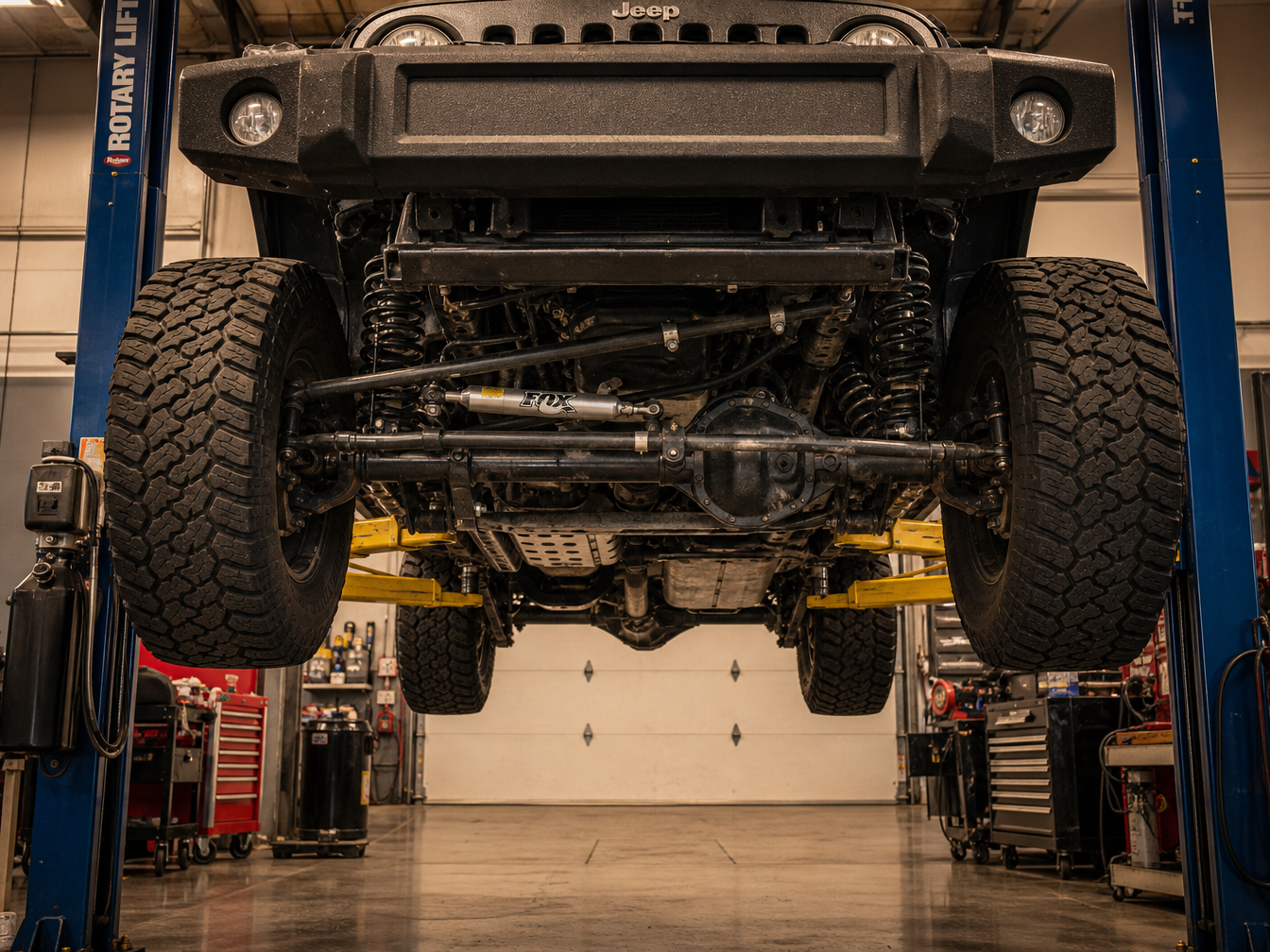
Target: Any model year — no generation-specific quality issues like the JK 3.8L. Rubicon for serious trail; the AdvanTEK Dana 44 axles front and rear, Rock-Trac t-case, and electronic lockers make it the strongest factory trail rig Jeep has ever sold. 3.6L Pentastar for the most predictable build path. EcoDiesel for overland and towing builds.
- ADAS systems — do all safety systems engage and operate? A used JL lifted without recalibration may have inactive systems
- Confirm ADAS has been recalibrated if the vehicle shows any lift modification
- 4xe: verify battery health report and confirm charging equipment is included
- Rubicon 392: different service intervals — know which buyer profile you are before committing
What Each Lift Height Unlocks — JK and JL Specifics Called Out
| Configuration | Max Tire | Notes |
|---|---|---|
| Stock | 32" (31.5" Rubicon) | Very tight from the factory |
| 2" spacer | 33" | Minor rubbing possible at full lock |
| 3.5"–4" suspension | 35" | Track bar correction required; minor trimming |
| 4.5"+ long-arm | 37" | Body modification required; full geometry correction |
JK-specific: Track bar correction bracket mandatory at 4"+. Without it the axle walks laterally and accelerates death wobble onset. We include it in every 4"+ JK lift quote — not optional.
| Configuration | Max Tire | Notes |
|---|---|---|
| Stock Sport / Sahara | 32" | — |
| Stock Rubicon | 33" factory | Factory-equipped with 33s |
| 2" spacer | 33"–35" | ADAS recalibration required |
| 3.5"–4" suspension | 35"–37" | ADAS recal required; some trimming at 37" |
| 4.5"+ | 37"+ | Body mod required; full ADAS evaluation |
JL-specific: Every geometry change — including spacer lifts — requires ADAS recalibration. We include this in every JL lift quote. It is not an optional line item.
JK & JL Wrangler Build Stages — One Honest Map
These ranges are approximate — not quotes. They reflect what these builds realistically cost in parts and labor with quality brands and no corners cut. The build gallery shows what each stage looks like finished.
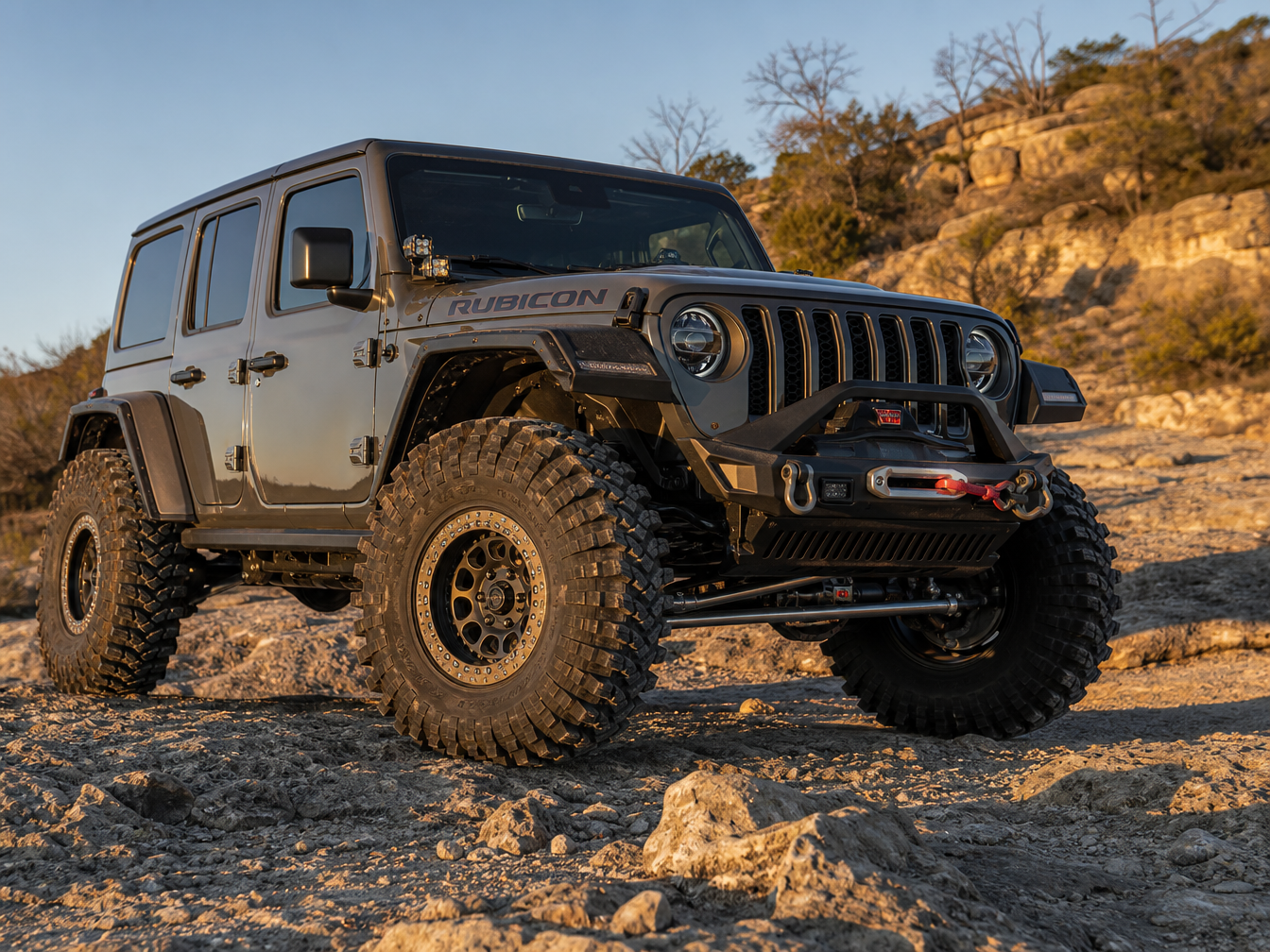
2"–2.5" lift, 33" tires, heavy-duty steering (mandatory on JK), JKU stiffener kit if applicable, skid plates, recovery bumper. The Demon steering fix is not optional — we include it at Stage 1 on every trail-focused JK.
3.5"–4" suspension with track bar correction, 35" tires, Dana 44 rear upgrade (non-Rubicon), rear locker, winch, full armor. This is the JK performing correctly.
Long-arm suspension, Dana 44 front upgrade, 37"+ tires, full armor package, cage or tube work where required. The JK performing at the top of what the platform allows.
2"–2.5" lift, 33"–35" tires, ADAS recalibration (standard, included), skid plates, bumper upgrade. The ADAS recal is not an add-on — it's in the base quote on every JL lift we do.
3.5"–4" suspension, ADAS recalibration at new height, 35"–37" tires, full armor, winch, locker addition on non-Rubicon. The JL Rubicon at Stage 2 is one of the most capable production-based trail vehicles available at any price.
Long-arm suspension, 37"+ tires, full armor, and a decision: full ADAS recalibration at new geometry (complex, shop-specific equipment required) or ADAS delete for a dedicated trail-only vehicle. We walk through this before the build starts — not after.
The Lift Kits We Run on Wrangler Builds — and Why
| Use Case | Brand / Kit | Notes |
|---|---|---|
| Entry | ReadyLIFT 3.5" | Bolt-on, accessible price, correct geometry |
| Daily / Trail | BDS 4"–4.5" | Strong daily/trail hybrid — our JK go-to |
| Premium | Metalcloak 3.5" Duroflex | JK-specific geometry engineering, trail-tested |
| Stage 3 / Long-arm | Teraflex, JKS Manufacturing | Both have mature JK-specific systems |
We don't recommend Rough Country above 4" on a JK without additional track bar correction hardware. The geometry doesn't correctly address caster at that height, and the shock quality doesn't last on Houston's roads. We install it when the budget requires it and the customer understands what they're getting. How we choose and spec every system is covered on our lift kits and suspension page.
| Use Case | Brand / Kit | Notes |
|---|---|---|
| Entry + ADAS | Mopar 2" Lift | Factory-tested, ADAS-compatible — our safest entry recommendation |
| Daily / Trail | TeraFlex 2.5"–3" | Excellent JL-specific geometry, our JL go-to |
| Trail-focused | ICON Stage 2 (JL) | Highest trail performance geometry in 3"–4" range |
| Premium | Metalcloak 3.5" Duroflex (JL) | Purpose-built for the JL — not adapted from JK |
| Stage 3 / Long-arm | TeraFlex, Dynatrac | Both have JL-specific long-arm systems |
ADAS recalibration is included in every JL lift quote regardless of brand or height. This is not negotiable on any JL. Every lift we do on a JL — Mopar 2" through long-arm — includes recalibration before the Jeep leaves our bay.
Best-in-Class Parts for JK & JL — Our Honest Recommendations
Suspension
JK: BDS, Metalcloak, TeraFlex, JKS Manufacturing · Adjustable UCAs · Track bar correction bracket (mandatory at 4"+) · JKU stiffener kit
JL: TeraFlex, ICON, Metalcloak, Dynatrac · ADAS-compatible hardware at every stage · JLU stiffener kit for Unlimited builds
Axle & Drivetrain
JK (non-Rubicon): Dana 44 rear swap · ARB Air Locker front and rear · Alloy USA chromoly shafts · Heavy-duty steering drag link and tie rod — mandatory on JK
JL (non-Rubicon): Dana 44 front upgrade · ARB Air Locker · AdvanTEK-compatible service parts
Both: WARN winch (9,500 lb+) · Factor 55 fairlead · Quality synthetic rope
Armor & Recovery
Rock sliders — Metalcloak, Poison Spyder, Nemesis Industries (JK-specific fitments) · Full belly skid system (engine, trans, t-case, fuel tank) · Tube front bumper with integrated winch mount · Rear bumper with swing-out and D-ring mounts
JK and JL have different body mounting points — armor must be platform-specific. We don't use universal brackets on Wranglers.
Lighting
LED bar, A-pillar pods, rock lights, bumper-integrated pods — all wired clean through factory firewall on every SJW build.
JL-specific: Factory A-pillar utility tracks purpose-built for auxiliary lighting. Use them — no custom brackets needed on JL A-pillar pods.
JK: Custom A-pillar bracket mounts; windshield-frame bar mounts without tie-down points — slightly different spec conversation.
Wheels & Tires
Both JK and JL share the 5×127 bolt pattern — full wheel compatibility between generations.
Tires: BFG KM3 and KO2 (most popular in the Wrangler community) · Nitto Ridge Grappler for rugged-terrain middle ground · Toyo MT for mud-focused Houston trail builds
Wheels: Method 305, Fuel beadlock, KMC Machete and Maze — JK and JL share fitment specs. TPMS standard on JL — always included in install.
Electrical & Electronics
JK: Relay panel for aux lighting · Dual battery for winch builds · Viair or ARB compressor for air lockers
JL: ADAS recalibration at every lift (in every quote) · 4xe-specific relay and charging integration · Dual battery for winch builds · Same Viair/ARB recommendation
JL electrical architecture is more complex than JK — modifications to factory wiring require more care. We document every circuit modification on JL builds.
JK vs. JL vs. TJ Wrangler — Which One Is Right for You?
The three-way Wrangler comparison the community debates constantly. Honest framing on all three — we'll tell you if the JL isn't the right answer for your situation. Looking at the truck instead? The Gladiator JT page covers the long-wheelbase build.
| Factor | TJ (1997–2006) | JK (2007–2018) | JL (2018–present) |
|---|---|---|---|
| Axle Stack | D30/44F, D35/44R | D30/44F, D35/44R | D30/D44 AdvanTEK |
| Best Engine | 4.0L I6 | 3.6L Pentastar | 3.6L / EcoDiesel |
| Factory Locker | Rubicon only | Rubicon (electronic) | Rubicon (electronic) |
| Death Wobble Risk | High | High (post-lift) | Lower (geometry) |
| ADAS Systems | None | None | Yes — recal required |
| Aftermarket Depth | Deep | Deepest | Maturing rapidly |
| Entry Cost | Lowest | Moderate | Highest |
| Trail Capability | High | High | Highest (Rubicon) |
| Daily Drivability | Moderate | High | Highest |
When TJ Is the Answer
You want the most analog Wrangler, the tightest footprint on technical terrain, or the deepest community documentation in Wrangler history. The TJ is more compact, more mechanical, and for many serious builders — more honest. It's not our specialty on this page, but we know it well.
When JK Is the Answer
You want the deepest aftermarket, the most proven build paths, and the most accessible entry price for a capable 4-door Wrangler. The JK's maturity works in your favor — every problem has been solved, every part has been tested. A well-built JK is still one of the most capable trail vehicles you can build under $20,000.
When JL Is the Answer
You want the most capable factory Wrangler ever made, you're building a Rubicon and want the AdvanTEK axle advantage, or you want the most refined Wrangler for daily use without compromising trail capability. The JL is the right answer for most buyers who are starting fresh in 2026. The ADAS requirement is a real consideration — but it's not a reason to avoid the JL. It's a reason to choose a shop that knows how to handle it.
Not sure which Wrangler fits your situation? Come in for our honest take →JK & JL Wrangler Questions. Answered Completely.
Ten questions we get from Wrangler owners every week. Real answers — not deflections.
Your Wrangler Deserves a Shop That Knows It.
Whether it's a JK you've had for years that's never been built right, or a JL Rubicon you just drove off the lot — we start every assessment the same way: where is it now, and where does it need to go.
We don't spec builds that don't match the use case. We don't install lifts on JLs without ADAS recalibration. And we don't hand you a JK back with factory steering if trail is your goal.
Houston, TX 77057
Sat 9am–4pm