Lighting Systems Spec'd for the Jeep Platform
A Wrangler JL has different mounting attachment points than any truck on the market. Hardtop and soft top Jeeps mount differently. Steel tube bumpers mount differently than factory. We spec lighting to the platform — not to a generic part list.
LED Light Bars & A-Pillar Pods
The JL Wrangler has factory windshield tie-down points and A-pillar utility tracks purpose-built for auxiliary lighting — and we use them correctly. Roof racks on JK and JL create a natural bar mounting platform without drilling. We spec bar length to your actual trail use and wire everything through the firewall clean.
- 20", 32", and 42" bar lengths in stock
- A-pillar pod mounts for JK and JL utility tracks
- Windshield tie-down LED mounts for JL
- Roof rack integration for Garvin, Gobi, and Mule
- Combo, spot, and flood beam patterns available
- Wired through factory firewall — no roof penetrations
Bumper & Grille Lighting
Steel tube bumpers on lifted Wranglers and Gladiators change where lights mount and how they wire. We fab custom brackets for common aftermarket bumpers and run wiring through the frame or along existing harness routes — not zip-tied to the bumper skin.
- Cube pod mounts for tube bumpers — fabricated in-house
- Fog light upgrades for OEM and aftermarket bumpers
- Bumper-integrated LED bars for JL and JK fronts
- Grille pod mounts for factory and aftermarket Gladiator grilles
- Sealed connectors at every junction point
- Wiring routed through frame structure, not bumper skin
Rock Lights & Underbody
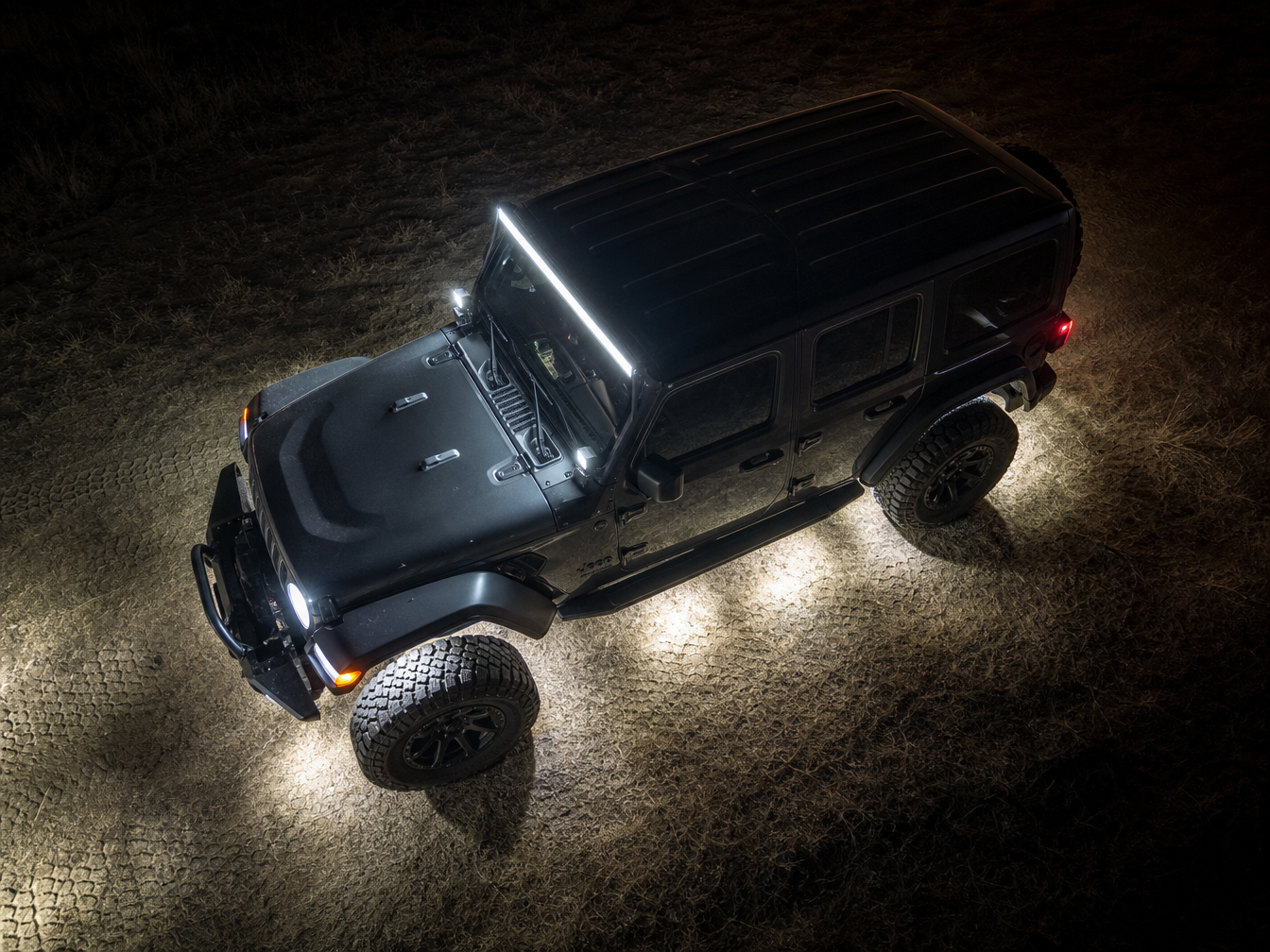
Rock lights on a Wrangler or Gladiator aren't just cosmetic — they're functional trail equipment. Lighting the wheel wells and rocker area tells you where your tires are at night and helps navigate water crossings without guessing depth. Sealed aluminum housings only — no plastic knockoffs.
- 4, 6, 8, and 10-pod kits in stock
- RGB and white single-color options
- Sealed aluminum housings — IP67 rated for rock and water
- JK, JL, and Gladiator wheel-well mounting positions
- Wired to dedicated switch or Bluetooth app controller
- Rocker and frame-rail coverage for trail navigation
Interior & Trail Lighting
Wrangler and Gladiator owners camp more than most. Interior lighting, dome upgrades, overhead strips, and footwell lighting all matter when you're setting up camp at midnight. Gladiator bed lighting and trail work lights handled in-house.
- Footwell and dome LED upgrades for JK, JL, and Gladiator
- Overhead LED strip lighting for soft top and hardtop
- Gladiator bed lighting — switched and waterproof
- Trail work lights for rear-mount and tire carrier positions
- Interior RGB with app control for camp mode
- Wiring through factory headliner channels — clean finish
Lighting Package Pricing Tiers
Transparent pricing, no surprises. All installs include wiring to fused, relayed, switched circuits — plus a post-install function check and aiming verification. Parts and labor included in ranges shown.
Fog Light Upgrade
- OEM-replacement LED fog bulbs or housings
- Plug-and-play or relay-wired install
- 1–2 hour install typical
- Improved visibility in rain and Houston fog
- Great starter upgrade for daily-driven Wranglers
LED Bar + A-Pillar Pods
- 32"–42" combo-beam LED bar — Jeep-mounted
- Pair A-pillar pods to JL utility tracks or JK brackets
- Switched relay harness with proper fuse
- Wired through factory firewall — clean
- Dash or windshield rocker switch included
Rock Lights + RGB Package
- 8-pod rock light kit, sealed aluminum housings
- RGB color-shift controller with app
- JK/JL/Gladiator wheel-well positions
- White trail mode + color modes programmed in
- Hidden wiring, fused and relayed
Complete Lighting Build
- LED bar, A-pillar pods, rock lights, interior
- Custom wiring with labeled switch panel
- Jeep-specific mounts — no universal brackets
- Houston street-legal color modes configured
- 2-year install warranty
Pricing varies by vehicle configuration, mounting complexity, and brand. Final quote after free in-shop consult.
Lighting Builds Off Our Bench
Every build is different. Here's a sample of recent lighting installs — each one spec'd for the Jeep, wired clean, and function-checked before delivery.
2022 Jeep Wrangler JL Rubicon
Bar to the windshield tie-down points — no drilling. A-pillar pods to the JL utility track system. Rock lights app-controlled with white trail preset and color camp mode.
2019 Jeep Wrangler JK Unlimited
Full app-controlled RGB system. Orange-and-black for game days, white-only for trail use — both programmed into presets. Wiring through factory frame channels.
2022 Jeep Gladiator Mojave
Grille bar for trail driving, bed strips for camp setup, rock lights for tire placement at night. All three circuits switched independently with a labeled rocker panel.
2021 Jeep Wrangler JL Sport S
Aftermarket tube bumper with no factory pod mounts. We fabbed brackets in-house, installed cube pods, upgraded the fog housings, and wired to a single relay harness.
2018 Jeep Wrangler JK Rubicon
Full roof-mount build on a JK with a Gobi rack. Bar to the rack structure, A-pillar pods on custom brackets. Labeled relay panel under the dash with a 4-position rocker.
2022 Jeep Gladiator JT Overland
Overland JT that camps most weekends. Grille bar for the trail, A-pillar pods on factory mount points, rock lights for camp setup and tire placement. 3-position rocker. Full function check before delivery.
Why Jeep Lighting Needs Are Different in Houston
Houston isn't California or Arizona. Our rain, our humidity, and our mix of interstate commute and East Texas trail driving means off-the-shelf lighting advice doesn't always apply here.
Rain & Humidity Demand Real IP Ratings
Houston gets over 50 inches of rain a year, and humidity alone corrodes cheap connectors inside of twelve months. Every harness we install uses sealed Deutsch or DT-series connectors, IP67-rated pods, and dielectric grease on every pin. On a Wrangler or Gladiator — where the underbody sees more water exposure than most trucks — cheap housing ratings aren't negotiable.
Hill Country & East Texas Trail Use
Weekend wheeling at Barnwell Mountain, Rocky Hill Ranch, or River Run calls for real output — not just style. We spec combo-beam LED bars with tested lumen output matched to the mounting height on your Jeep. Rock lights get sealed aluminum housings. A Wrangler that actually crawls needs lighting that actually works.
Daily Driving on I-10, 290 & the Beltway
Most of our Jeep customers daily-drive the rig. That means street-legal color modes on RGB, properly aimed auxiliary lights that don't blind oncoming traffic, and lights wired through relays so nothing draws parasitic current when the Jeep is parked. Lifted JKs and JLs that commute on I-10 get the same clean install as the ones that only see trail.
Texas DOT & Covered-Light Laws
Auxiliary lights above the headlight plane must be covered or switched off on public roads in Texas. On a lifted Wrangler with roof-mounted lighting, this matters. We install lens covers on every roof-mounted bar by default and wire A-pillar or bumper pods to a dedicated switch — so you stay legal on the highway and have full output on the trail.
How to Choose the Right Lighting Setup for Your Wrangler or Gladiator
There's no single right lighting kit — the answer depends on how you use the Jeep. Here's how we help Wrangler and Gladiator owners decide — and why the in-shop consult matters as much as the install.
Start With How You Drive Your Jeep
Daily-driver commuters benefit most from fog upgrades and bumper pods — quick to install, highway-legal, and a real visibility gain on foggy Houston mornings. Weekend trail runners need A-pillar pods and rock lights more than a roof bar. Overlanders building out a Gladiator or JL want a full platform approach. We ask about your use case first, then spec around it. Planning a night trail run? Know what to check before you wheel.
Hardtop vs. Soft Top Matters for Mounting
A JL hardtop has factory utility tracks and windshield tie-down points designed for auxiliary lighting. A soft top JL has fabric and bows — you can't run a roof bar the same way, and mounting through a soft top creates weather exposure. We'll tell you which options actually work for your configuration and which ones will cause problems six months from now.
Lumens vs. Beam Pattern
Raw lumen numbers are half the story. A flood beam fills the road close but does nothing past 100 feet. A spot reaches 1,000+ feet but is useless for close-quarters rock crawling. Jeep owners typically need a combo beam for the combination of trail terrain and occasional open road. We pair beam pattern to how you actually drive — not what looks best on a spec sheet.
Wire It Right or Wire It Twice
80% of the lighting problems we fix are from someone else's wiring job. No fuse. No relay. Bare copper behind the dash. On a Wrangler — where the interior and underbody see more water than most vehicles — bad wiring fails faster. We wire every install to a fused, relayed, properly gauged circuit with labeled switches and a schematic you keep.
What Actually Goes Into a Clean Jeep Lighting Install
The difference between a good install and a great one is in the details you can't see. Here's what we do on every build.
Relays, Fuses & Proper Gauge Wire
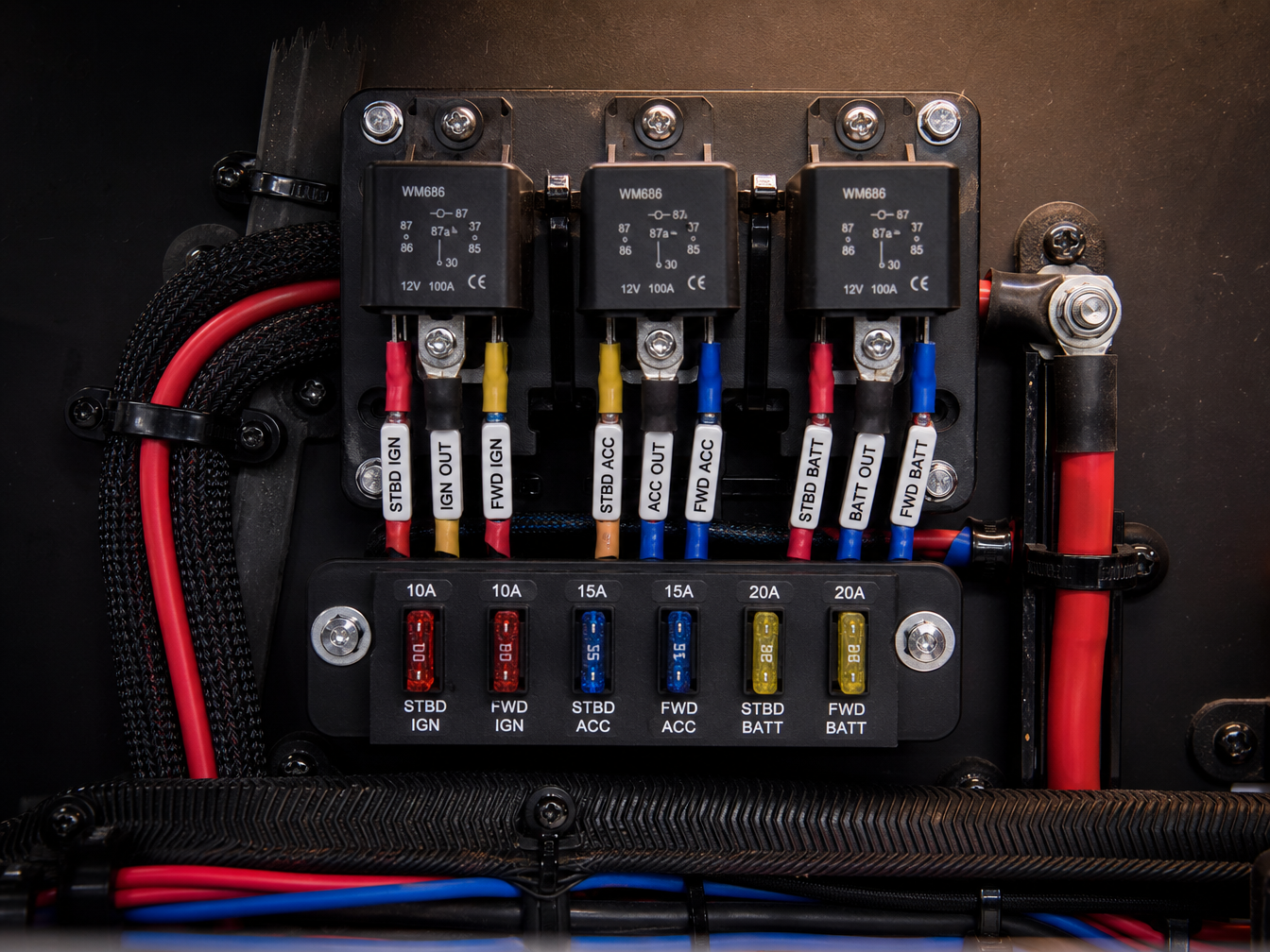
Every aux light gets its own relay triggered by a low-current dash switch — not the switch carrying full amperage. Circuits are fused at the battery within 6 inches, matched to the load. Wire gauge is sized for the run length using marine-grade tinned copper to resist Houston humidity and underbody water exposure on a Jeep platform.
Harness Routing on a Wrangler
Harnesses on a Wrangler route through factory firewall grommets, along existing harness channels where possible, and away from any flex points in the soft top frame or bikini top hardware. On JK and JL builds, we use factory routing channels through the A-pillar for pod wiring — a clean install should be invisible when the door is open.
Grounding Done Right
Bad grounds are the number one cause of flicker, color shift, and premature LED failure on any rig. On a Wrangler that sees water and flex, ground corrosion accelerates. Every light gets a dedicated ground to bare metal, star-washered, and sealed with dielectric. RGB controllers get a star-ground back to the battery negative to prevent voltage drift.
Aiming & Function Check
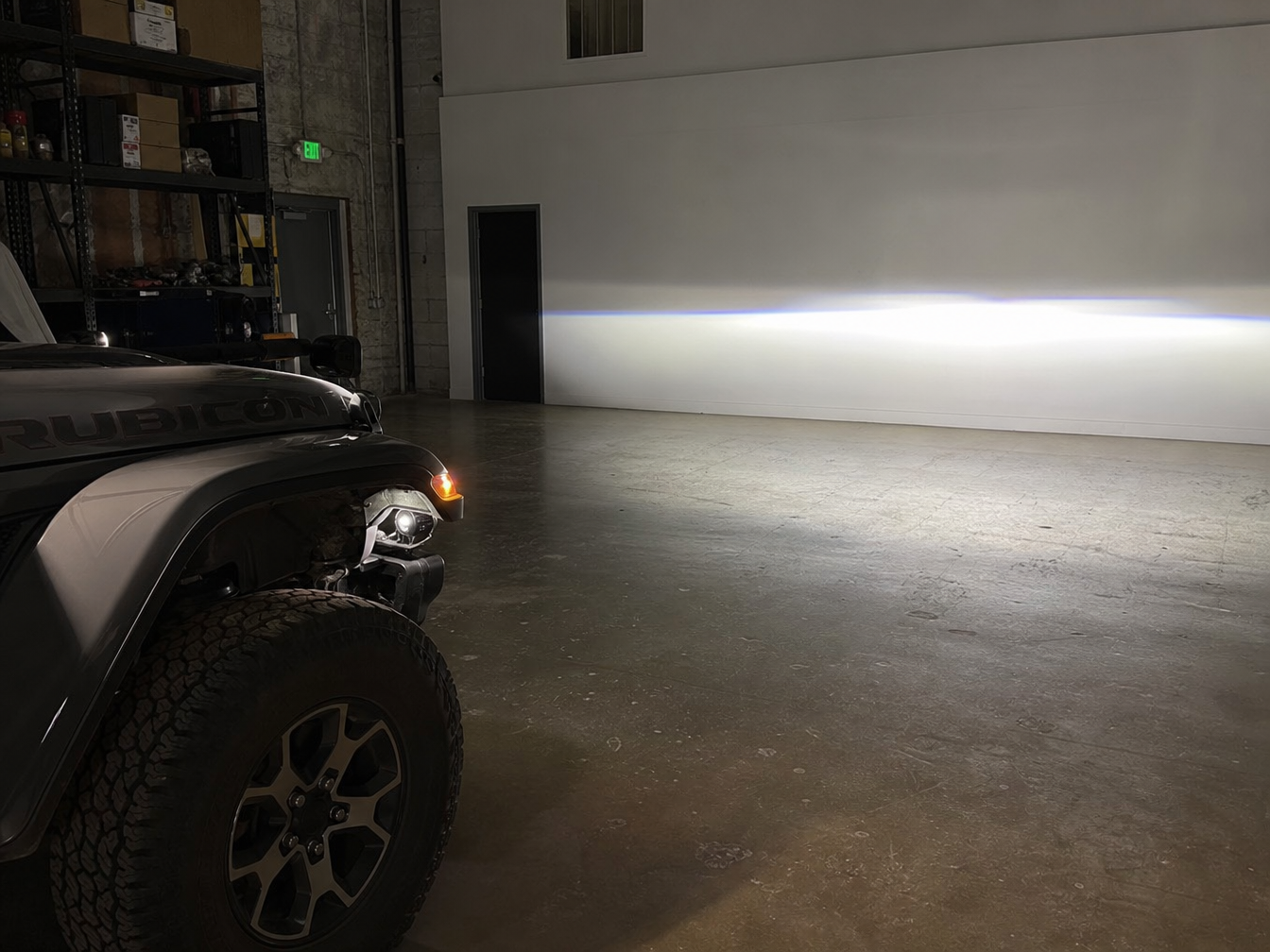
After every install we aim auxiliary lights correctly — roof bars aimed level with the road at speed, not down at the hood. On a lifted Wrangler, factory headlights often aim up after the suspension raise — we flag this and correct it as part of the aiming check. Everything function-tested before the Jeep leaves our bay.
What Jeep Owners Are Saying
4.9 stars across 127 verified Google reviews.
"Did a full A-pillar pod and roof bar build on my JL Rubicon. They used the factory windshield tie-down points and utility tracks — not a single drill hole in the Jeep. Wiring runs through the firewall clean with no visible harness. Four trail runs since the install and not a flicker. This is the only shop I'll use for lighting."
"Full RGB rock light setup on my JK Unlimited. App control, white trail mode, orange camp mode — all programmed before I left. They ran the wiring through the factory frame channels, not zip-tied to the undercarriage. Insane attention to detail. Worth every dollar."
"Came in after a bad install left exposed wiring behind my aftermarket bumper. Summit Jeep Works fixed the damage, rewired everything to a proper relay, and installed new fog pods with sealed connectors. Honest pricing, no upsell. I'll be back for rock lights this spring."
Jeep Lighting Questions, Answered
Jeep Lighting Installation Across Greater Houston
Our shop serves Wrangler and Gladiator owners from across the Houston metro and beyond. If you're within a reasonable drive, we've probably wired a Jeep from your zip code.
Houston, TX 77057
Sat 9am–4pm